Sorry, Mom

From www.loving here.com.
From http://www.loving here.com.

It has recently come to my attention that a number of the most annoying things my kids do are exactly the same things I did to drive my mom crazy as a child. It would be reasonable to assume that such self-reflection would make me more patient and forgiving, but sadly this is not the case. It does prompt me to beg for my mother’s forgiveness, however. Better late than never.

Dear Mom,

I’m so sorry that I:

  • wandered off with the good kitchen shears/scotch tape/screwdriver/all the pens that work and then lost track of them.
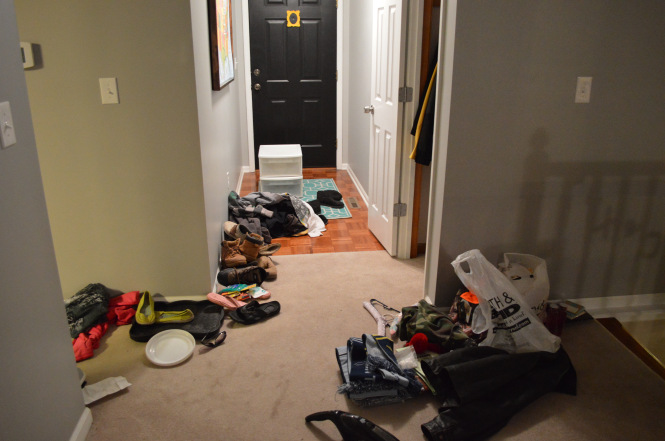
  • dropped my backpack, coat, lunch box, boots, bags, and everything I owned in the doorway, leaving it for everyone to trip over.
  • used up all of the toilet paper and then proceeded to use up all of the Kleenex instead of hunting for a new roll.
  • interrupted you for the 23rd time in a row.
  • relocated my pile of stuff to the stairs when forced to remove it from the doorway.
  • couldn’t find my drugstore sneakers/homework/lunch/field trip slip and made everyone late, even though I said I was ready to go, and I’d spent the previous 30 minutes goofing around.
  • yelled “Mom!” from the top of the stairs repeatedly until you dropped everything to come to me.
  • left my dirty dishes everywhere but the dishwasher.
  • begged to stay up late and then was miserable and crabby for the next 2 days.
  • asked for help with homework and then said, “that’s not what we’re supposed to do.”
  • insisted on doing something myself and then lost it/spilled it/broke it/got hurt.
  • repeatedly said I did not need to use the restroom and then–five minutes down the road–suddenly had an emergency.
  • repeatedly rolled my eyes and said, “you don’t understand” in that egregious tween tone.

I’m well aware that these are not the worst of my transgressions, but simply reflect the level at which my kids are now competing. Here’s hoping that some of your patience and humor will eventually rub off so I manage to weather the tween years and beyond.

By the way, now I know what you mean by “what goes around comes around.”

Feel free to say, “I told you so.”

Your loving daughter.
 

My Father’s Compass

newspaper2010 sm
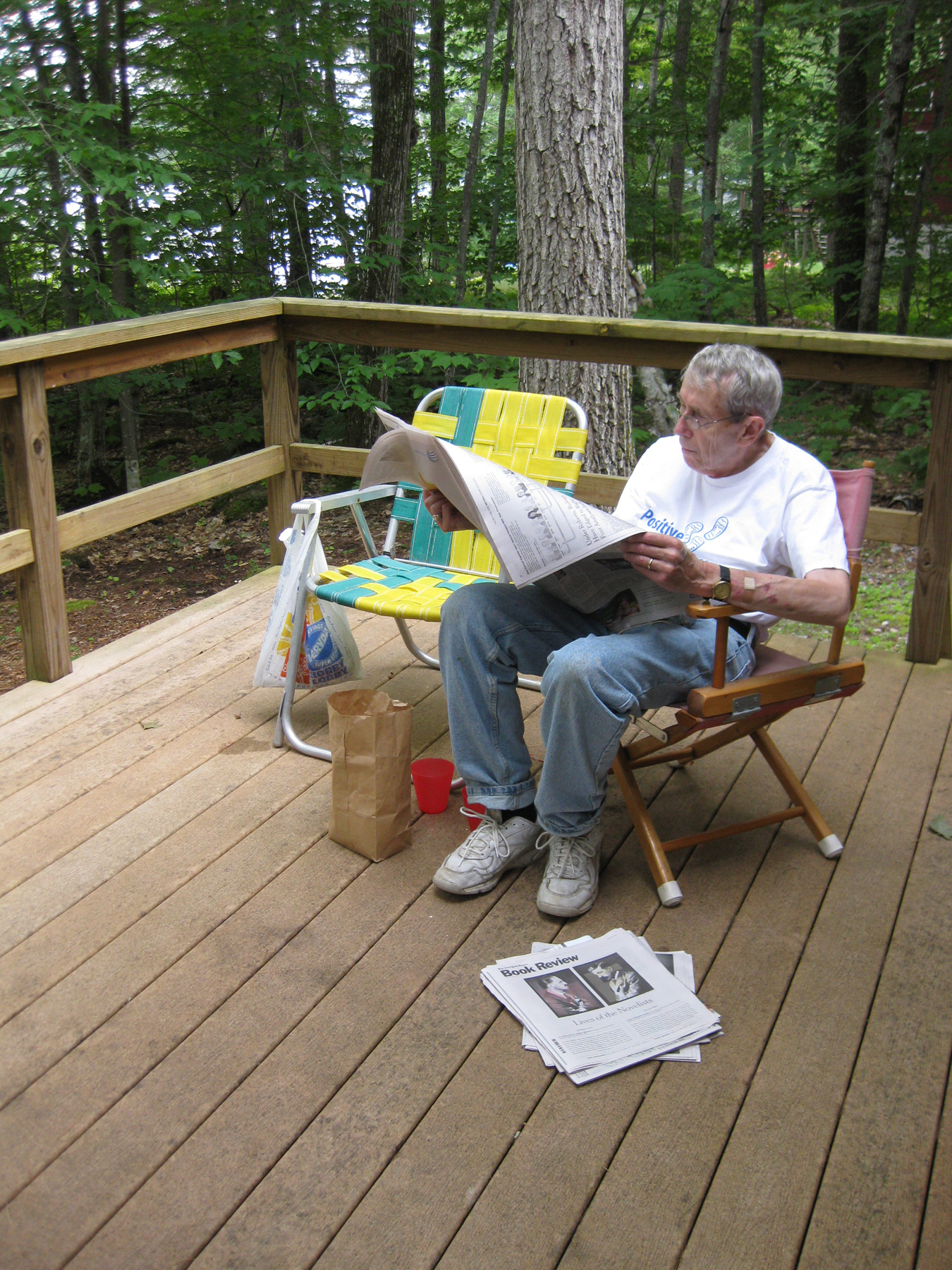
A few priorities: the newspaper, a snack, and a view of the lake.

When my father would visit, he had a knack for hunkering in with the MacNeil News Hour while my kids fussed and cried. I was usually busy burning something on the stove, entertaining telemarketers, arranging carpools, or hunting for very important lost items. I didn’t have a lot of time to chat. After wrestling the girls into bed, I would slump down the stairs, and Dad would glance up from his mountain of New York Times. “Say, have you read this editorial about inner city schools?”

I never had.

How I wish I had been able to stay awake then, to engage in conversation about something other than logistics and rashes. Later, when he couldn’t talk much at all, I felt such a tremendous loss. What I would have given–then, and now–to hear his thoughtful analysis, his historical anecdotes, even a little about the book he was reading. I have so many questions that remain, so many gaps which I long to fill with stories from his rich life.

But one cannot render a portrait of a man or a relationship with a macro lens, focusing on a single moment, of which there were two and a half trillion in his 84 years. Examining just one of these does neither of us justice.

Thankfully, there are other moments to cling to–moments that are easier to carry: the theologian on all fours, mooing, while my small girls shrieked and giggled. The tiny, illegible notes my father squeezed into the margins of mom’s chatty letters–notes full of the gratitude and humility with which he approached life. The time I called him on Fathers’ Day a couple of years ago. After a discussion of his day, the weather, Sunday dinner, he paused and I awaited his goodbye. He said, instead, “I wanted you to know: you are a blessing.”

I have been surprised and relieved to discover that my relationship with my father endures–grows, even–as I hear stories from friends, family, and strangers. They share glimpses I couldn’t see from my age or perspective. I am reminded that though his body has betrayed him, he has not been diminished by mortality. Instead, these stories add flesh to the bones I have known over the years.

Still, I will not pretend that I can see him in full. Who could? Yet here is what I know for sure. My father asked a single question repeatedly during his sojourn on earth: How then shall we live?

This was the question that guided his thoughts, his decisions, his direction. He believed we should take a look at what we believe to be good, right, or best, and use that as we go gently forth into the world. He forged a compass from his heart and faith, and as I try to follow in his footsteps, I find he is walking with me. He is alive in my struggles, my questions, and my actions. He is here, helping me as I choose what I think is best; helping me to set my own compass.

Why the %@$!! is baby crying? Coping with the gray area

treehouse

My oldest brother built a tree house nestled in the power lines, about twenty-five feet off the ground. It had glass windows, plus who knows what other amenities; I never went up there to see. By the time I was old enough to climb trees, his fort wasn’t in the best of shape anymore. Also, I was kind of a chicken.

But I would gaze up at it, and wonder how in the world our mother could watch her boy shimmy up that tree with hands full of nails and saws and glass. There he was, teetering outside her authority, outside her ability to keep him safe.

“How did you know he would be OK?” I asked her once, long before having kids of my own.

She thought for a while before answering.

“Being a parent is hard,” she said finally.

This was my first glimpse into the gray area of parenting, but it was years before I figured out that most of parenting is spent meandering around in the unknown.

There is a game called “Why is Baby Crying?” which consists of a set of dice printed with phrases like “dirty diaper” “sleepy,” and “hungry.” I didn’t understand the premise at all–let alone the humor of it–until I was holding my own wailing newborn, wondering what in the world was wrong.

“Why is she crying?” I asked my mother, since I had tried everything I could think to soothe her. My mom had had four kids, after all, and we were alive and well. She must know something.

“I don’t know,” she said.

Now what?

Maybe the dice should have said “I don’t know” on every side, or offered suggestions that frazzled, sleep-deprived parents might neglect to try. You know, such as:  “put baby down and take a deep breath,” or “have a glass of wine,” or, even better, “find a friend to watch the tiny tyrant for an hour.” There is no secret path around the gray area, just a few tools to clutch while you fumble through there.

Now that my kids are eight and ten, I’ve learned to tolerate some of the gray area with a little less anxiety. However, if I had the chance to sit someone down who KNEW ALL OF THE ANSWERS–someone like Dr. Spock was supposed to be–I would have a few questions.

Here are a few that have crossed my mind lately–feel free to add yours in the comments section.

*How do you know when to head to the emergency room, and when to say “walk it off?”

*How do you balance everyone’s needs so that your kids feel safe and loved, and you don’t lose your cool, identity, relationship, or mind?

*How do you quickly restore domestic harmony when your spouse gives your child three or four times the recommended dosage of Milk of Magnesia?

*What’s the nicest possible way to explain to your child that her favorite jacket and uncombed hair make her look like a homeless person?

*How do you guide your kids to make better decisions without them noticing and becoming resentful?

*What’s the best way to survive a child’s birthday party with a hangover?

*How do you keep your sense of humor when you get a flat tire, the brakes go out, the hot water heater spontaneously combusts, and you get a parking ticket all in the same weekend?

*How can you warn your kids about the dangers of the world without terrifying them or–worse–getting them excited to flirt with disaster?

And, last but not least:

*If child #1 has a fever of 104, has been crying and moaning for hours, but finally gets to sleep, and then her older sister leans over and vomits all over her bed, do you wake her up and change the sheets, or wait until morning?

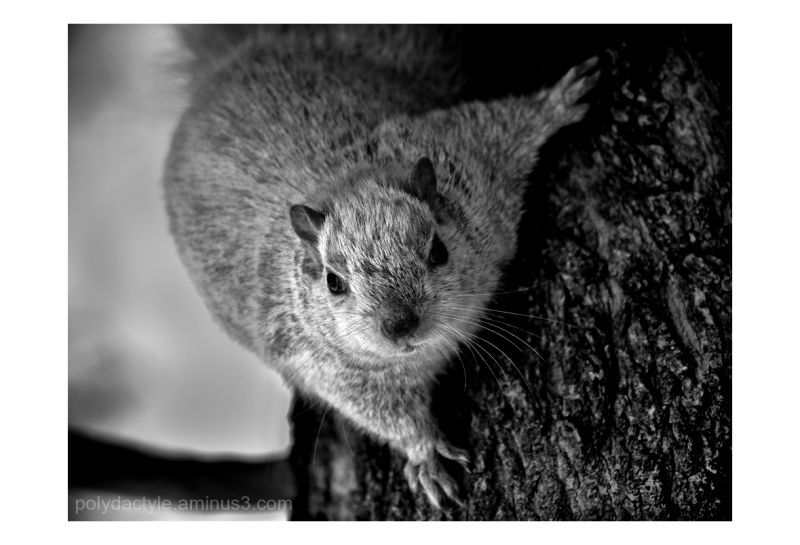
Squirrels

From http://polydactyle.aminus3.com/image/2009-01-17.html

Before the avocado linoleum was replaced, our kitchen table sprang from it on one hefty leg, like a flattened tree. We gathered round in our designated seats, though I can’t recall how or when they had been assigned. My mother sat closest to the fridge for handy mid-meal retrievals, with my sister and me to her left. Next was my father, followed by my two brothers, their backs to the window, completing the circle. I didn’t envy them; it was often chilly on that side, and accompanied by a view of the sink and the dirty pots on the stove. From my position, I could watch the flakes fall, or the morning glories creep up the strings that dangled over the window–our homegrown awning.

In the absence of some or all of the others, the seating plan still applied. My mother and I often leaned our elbows on the creaky oak to talk about books or logistics or ideas, one eye scanning the backyard.

Mid-conversation, it was not unusual for her to yelp and leap from her chair, grab pots and lids, and run outside, clanging like crazy.

After a minute or so, she would return to her seat, contrite and subdued, but the moment was gone, our thoughts dispersed.

I learned not to take this personally.

Her beef was not with me, but the squirrels who continually ransacked the bird feeder, leaving the cardinals, sparrows, and chickadees to forage elsewhere. No one pitied the greedy blue jays, at whom my mother clucked disapprovingly. They got any scraps the rodents left behind.

My mother greased the pole of the feeder, then sprinkled birdseed on the ground, either as a peace offering or to make the squirrels too fat and lazy to attempt the slippery pole. Nevertheless, the fuzzy little gluttons somehow always managed to shimmy up to the feeder.

Now that I am grown, I have a feeder out for the hummingbirds, but it hangs near the house, pole-less, in just the right spot to torment the cat. The squirrels and I co-exist quite amiably.

And yet, I see myself behaving like my mother, minus the pots and pans.

Half-listening to my girls, I am hyperaware of any unusual activity just past the membrane of our home-space. I’m there, but not fully; I’m coiled to spring.

Wondering,

why is it so very hard to be in a single moment,

instead of watching vigilantly

for squirrels,

or not-squirrels

on the periphery of our daily lives.

Weekly Photo Challenge: Grand


©Beret Olsen
©Beret Olsen


I love, love, love shooting film. One has to slow down and contemplate the light, meter here and there, think in two dimensions, adjust the tripod. It is slow and meditative for me, in part because the equipment is so unwieldy, in part because the film so expensive. Each frame matters.

But this image was not shot on film. In fact, I’m lucky it exists at all.

Here’s the deal.

When I am with the spouse and kids, there is never a good time to take a photograph. I’ve missed many, many shots in the interest of “making good time,” catering to emergency bathroom and snack needs, or these days, trying to avoid the tween’s biting impatience.

My family will probably disagree–and for good reason. In truth, they have stopped and waited innumerable times for me to dig out my phone or a point-and-shoot. I take a ridiculous number of crappy snapshots on a daily basis, but the resulting images feel more like visual markers than like “real photographs.” Some are interesting, or serve to jog the memory, but most of them are jpeg trash. I save them anyway.

On the morning pictured, we were supposed to have hit the road an hour earlier. It had taken longer than expected to pack and leave our lodging, which was probably my fault. Two minutes into the drive, we had to stop and return Red Box movies. Five minutes later, we had to stop again to get gas and dig snacks out of a bag buried in the back. Finally, we were rolling. Everyone was a bit cross–and more than ready to get a few miles under the belt–when I saw the most amazing light coming over the lake and snow. I turned to my beleaguered family and smiled weakly. “So. I…uh…need to pull over for a sec.”

Sadly, I didn’t have my real camera along, but I grabbed the point and shoot and got out of the car. I slowed down for two minutes and really looked. I futzed a little with the framing and exposure. I walked closer, forgetting for a moment that there were three grumpy people back in the car.

It may not be the best possible photo, but it makes me very, very happy. In the midst of the manic, chaotic snarl of everyday finagling, it is possible to breathe and see and be in the present. And even if it’s just for two short minutes, it can be grand.

How my mom killed Santa

©2013 Beret Olsen
©2013 Beret Olsen

When I was little, I went to Prairie Market with my mother to do the month’s shopping. Prairie Market hawked groceries at a grossly reduced rate, leaving everything in shipping cartons in an unheated warehouse. Since it predated the days of ubiquitous scanners, we dug cans of soup out of the crates, and wrote the price on each one using a red wax pencil. I got to ride around on a platform hand truck instead of in a janky cart.

In a weird, frugal way, it was awesome.

On one fateful shopping trip, however, I looked up from my can-labeling extravaganza to see my mother sneaking Christmas candy into our pile of supplies. This might not seem like a big deal to you. Keep in mind that–except for a pack of Trident gum in the kitchen cupboard–we never had candy in the house. I came unhinged. I made a huge scene. Demanding to eat it then and there, I fussed and begged and whined until my beleaguered mother thrust a small, foil-wrapped Santa at me, allowing me one single bite.

She wrapped the chocolate back up neatly and paid for it with the rest of our haul.

Then…weeks later…

On a cold and jolly winter’s morning, I reached into my stocking and pulled out a half-eaten Santa.

What??!!

I immediately marched over to inform my siblings, two of whom offered feeble explanations; the last looked away, likely stifling a guffaw. What was this, I wondered? Could they not handle the truth? I squinted at them–perhaps with a bit of pity–not realizing the absurdity of the situation: a six-year-old unveiling life’s truth to a room full of teenagers.

*****

Cut to this year.

At around 10:30 pm on Christmas Eve, I was crouched on the floor beside the bed, reading my godforsaken, depressing book by headlamp, trying to stay awake without disturbing the spouse.

Must. Stay. Awake.

I know. That was pathetic, given the hour. It’s not like I had to make it through midnight mass or anything. But, after two weeks of insomnia and holiday hullabaloo, I was really ready to hit the hay.

Trouble was, one of my kids was on the couch in front of the stockings, holding some sort of vigil. Whenever I thought she must have dozed off, I would tiptoe to the top of the stairs and look down, only to witness her stirring, waiting, watching.

I was torn. Don’t my kids know who plays Santa, anyway? Wasn’t that the reason for her vigil, to have real proof beyond past year’s mistakes and discrepancies, such as:

How come this present is wrapped in paper we have in our office closet?

Why is my friend’s Santa so much more generous?

and

Why didn’t Santa bring what I really wanted:  an iPhone?

If I just bailed and went to bed, I’d be fresh for the morning. I could stick some gifts in the stockings after sunup, right? It’s the same stash, either way.

Suddenly, I felt an overwhelming sense of empathy for my mother, the Santa-killer. I was by far the youngest of four kids. She had been willing herself awake for eighteen Christmas Eves so that some imaginary person could take the credit for all of her thoughtful work. That woman was done.

Sigh.

I’ve only been at it half as long. I can’t yet bail in good conscience.

Ho, *#^%(!), ho.

Firstborn

From ingaphotography.wordpress.com

I was shell-shocked, sleepless,

mostly numb for three days straight.

On the fourth day, I was holding our tiny creation, mesmerized by her miniature, spastic gestures,

when I felt a sudden rush of sorrow and overwhelming futility.

Who am I to invite someone new into this crazy world?

Though fierce when provoked, I am so small, my shell hopelessly permeable.

What protection can I offer this perfect and vulnerable creature?

I wept for the confusion in store for her, for the first time she will be disappointed–perhaps by me–

And for the first time her heart will be broken.

How right you were, Mrs. Rosine

My eighth grade English teacher made us memorize poems and recite them in front of the class.

“Someday you’ll thank me,” she said. “What if you’re sent to prison? How will you make the time pass?”

Two years later, we stopped for tea with relatives before starting a 200-mile drive.

I gripped my warm mug and eyed the drifting flakes, tuning out my aunt’s cheerful banter.

Then, rolling at last,

The heavens opened

And deposited a great wall of snow in front of our Chevy.

Piled atop each other, we spent the next cramped hours

with

Emily Dickenson

Robert Frost

Edna St. Vincent Millay

and

William Shakespeare

The Brother of Invention

Our campsite--without my brother's addition.
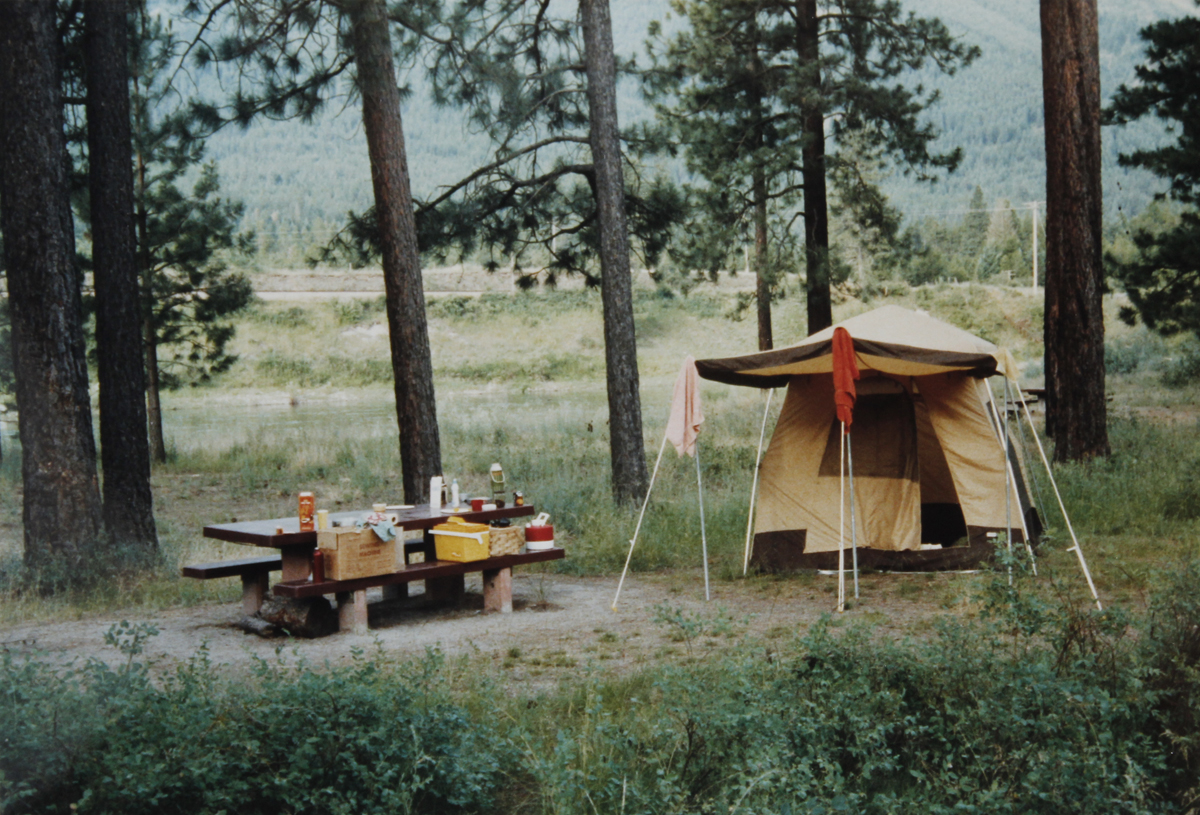
One of our campsites–without my brother’s addition.

For years we slept together in one tent,

All six of us

Plus cat and dog.

As the youngest, I was tucked into the seams, farthest from the snoring heap of dad…

An unfortunate location on rainy nights.

When he hit high school, middle brother learned to sew.

Out of ripstop nylon and seam-sealer, he carved a modicum of personal space for the hours between dish duty and daybreak.

Groggy and stiff from hugging the lumpy terrain, we drank Tang out of Solo cups, stamped our feet to keep warm, and crammed back into the Chevy for the next 500 miles.

From www.etsy.com
From Happy Fortune Vintage on http://www.etsy.com

On Being Scandihoovian: Probably Part One

©2010 Beret Olsen
©2010 Beret Olsen

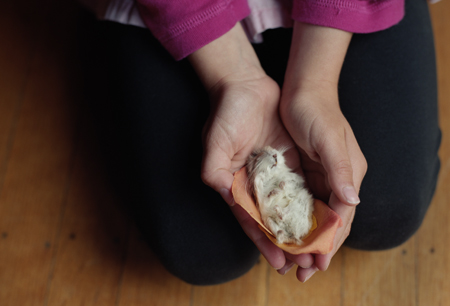
Not long ago, an acquaintance walked into my entryway and stared at a photograph I had taken of my daughter holding her pet hamster.  “Is that guy dead?” she asked me.

I suddenly felt very, very uncomfortable.

“Uh, yeah,” I said, unsure whether to feel embarrassed or ashamed. I picked both.

She looked at it for a long, uncomfortable moment before announcing: “That is sooooo Scandinavian.”

I had no idea what she meant, but since I’m 100% Norwegian, I figured she might be on to something. It was time to investigate.

I have relatives who swim daily in the ocean off the coast of Oslo, and run around their mountain cabin naked in the middle of winter–no doubt after a good dose of Aquavit. I can assure you that this is not what it was like for me in my childhood home. My parents are the sort that drink a thimble-full of red wine for medicinal reasons, and comport themselves in a dignified manner at all times. I think I’ve heard them raise their voices three or four times in my entire life.

Growing up, I was carted off to Junior Sons of Norway on Saturdays, where I learned the Norwegian national anthem–which I can be easily enticed to sing, with great enthusiasm–and Min Hatt, Den Har Tre Kanter (My Hat, It Has Three Corners, a deep and lyrical song, as you ca imagine). I was fed Lutefisk (fish soaked in lye) once a year, and taught to say grace in Norwegian whenever we excavated the dining room table and broke out the china.

I associate my ethnic roots with a palate-numbing dose of pickled herring, passed like treasure in a tiny, silver-rimmed dish at Christmas dinner. In fact, Christmas arrived with a long list of Scandinavian things I can’t and/or won’t eat:  Swedish meatballs, fruit soup, lefse, herring, rice pudding. (Sorry, Mom. I love you.) My mother would hide an almond in the rice pudding, and whoever found it got an extra present on Christmas Eve. I loved this tradition, but despised rice pudding. I would shove a spoonful around on my plate, and if I couldn’t find a nut, try to reorganize it in a polite way which simulated ingesting an honorable amount.

But I think it goes much deeper. Those Norwegian immigrants were unflinching, hardworking, stoic powerhouses in the face of the adversity and desolation of the Plains. In fact, my name was plucked from Ole Rolvaag’s Giants in the Earth, a chronicle of Norwegian immigrants in the Midwest. I have visited his house multiple times, read articles, and listened attentively to stories about him, but I have never, ever been able to make myself read the book. Here’s why: from Wikipedia, “The novel depicts snow storms, locusts, poverty, hunger, loneliness, homesickness, the difficulty of fitting into a new culture, and the estrangement of immigrant children who grow up in a new land.” What’s more, I heard my namesake has a paralyzing case agoraphobia.

“Is it true Beret goes crazy in the book?” I asked my mother. “Why would you name me after a character like that?”

There was a quiet pause.

“She really pulls it together in the second book,” my mother said, finally.

How Scandinavian.