The Unbearable Lightness of Being

“You’ve got to be very careful if you don’t know where you’re going, because you might not get there.” Yogi Berra

©2013 Beret Olsen
©2013 Beret Olsen

FYI:  This post is not really about the book.

I read it, though. I even saw the movie. I acted all impressed, and I suppose I thought I was. Despite all the raving, however, and despite Milan Kundera’s remarkable portrait of Czech society during a Seminal Historical Period, the story I read was about one man’s shameless infidelity and his meek and accommodating wife.

What I love is the title. Whatever the author meant by it, those five words distill the magic and misery of being a grown up: the unbearable lightness of being.

Every time that phrase surfaces, I imagine shifting, amorphous shapes, rendered almost completely unintelligible due to some blinding backlighting. It’s as if I am emerging from Plato’s cave for the very first time, or–rather less grandly–as if I am staring into the setting sun through a filthy windshield. No matter how hard I try to focus or shield my eyes, I cannot make out what I am hurtling toward.

No one says it out loud, but everyone seems to believe that eventually we’ll know what we’re doing, where we’re going, and what it all means. We’ll feel Grown Up, and life will feel defined. It’s a grand fallacy we buy, and oh, how alluring.

By my early twenties, I was already itching to feel grown, to know who and what I was becoming. I needed to figure it all out, because I wasn’t handling the gray area very well.

Here’s the problem: it’s all gray area. It’s all undefined, and not just when we’re 23.

When things seem to be black and white, it’s a cognitive short cut, a decision to see the world that way. While we may not determine our material circumstances, we do create our interpretations of them, and forge theories about ourselves and our lives. We need to believe things are clearly defined now and then in order to plow ahead with enthusiasm.

I once had a long talk with my sister about marriage. I wanted to know how she knew it was the right decision; how she knew that this was the right guy. She admitted that there was no such thing as 100% certainty, but once you married, you no longer had to continually ask yourself: is this the right person? You started from the idea that it was, and figured out how to handle whatever was coming your way from that vantage point.

Of course perspectives evolve and change, but if we don’t adopt one, we can’t focus in any direction. We lose traction and go nowhere at all. Contrary to how it may appear, choosing a direction isn’t limiting, it’s what makes movement possible. When I allow myself to wallow in the gray area, I limit myself. When I wonder, “Am I really a writer?” I waste a lot of time and energy on this question, instead of simply saying, “I am writing. How can I continue in this direction?”

In the interest of full disclosure, my sister got a divorce. Still, I don’t think that negates the power of what she was saying. Picking a direction only means that we are more likely to get somewhere, it doesn’t guarantee that we will.

September 11, 2001 is an extreme example. It was a clear, beautiful day, and the collective mood had adjusted accordingly. Moments later, when the sky was engulfed in a fog, when it was raining detritus, and fear swallowed the streets, people could not process what was happening. Part of the shock was having to acknowledge the gray area, the great unknown that is life. On that deceptively sunny day, people thought they could see where they were going; they believed that they were headed to work, when actually they were passing through a portal to hell.

This is not a message of doom and gloom, however. Thankfully, we are not always teetering on the brink of an abyss. We just don’t know exactly where we are going. We can’t control other people and events. To be honest, we can’t even control our own actions sometimes. The best we can do is to figure out what and who give us joy, what values and issues are important to us, and how we can contribute to make the world a better place. Then, we can surround ourselves with those people, work on those projects, and head in that direction. But we need to do this while being open to uncertainty. We need to be flexible enough to learn from our mistakes and the changing world around us.

The good news is, when the cracks become visible, when our current perspective is shattered, we can sift through the pieces to make a new place from which to stand, a new perspective that is just as true. It just takes a while to make a new map and start to trust the road.

A friend called me one night not long ago, completely agitated, to ask me, “Who are all those people, smiling and walking down the street like they know what they’re doing?”

Those people are you and I, my friend, on a day when things seem clear.

Five Ways to Procrastinate More Productively

From: http://thewritersadvice.files.wordpress.com/2012/04/procrastination.jpg
From: http://thewritersadvice.com/2012/04/…which just so happens to have some advice on avoiding procrastination altogether.

It occurs to me that I have become pretty adept at procrastination. Maybe I should write a few how-tos.

When I mentioned this to a friend, she responded enthusiastically:

“Ooh! Contemplate the cat. Play Age of Empires. Watch the Biggest Loser finale over two days, in 5 minute increments; sob hysterically, and pretend it’s allergies.”

“No, no,” I said. “I mean how to procrastinate productively.”

“Isn’t that a contradiction in terms?” she wondered. A reasonable question, but I think not.

Here’s how I discovered the vast potential of my avoidance strategies: I foolishly promised someone I would read Proust, so that we could engage in some Heady Discourse. I didn’t promise to read all 4,211 pages, mind you; not all seven volumes. Just the first one:  Swann’s Way.

I bought the thing in hardcover by accident, and it was just so crazy big, so heavy-looking and heavy-feeling, that I could not coax myself to get past the first ten pages. It did, however, make me feel terribly guilty sitting there, so I started to tackle other, less intimidating material I had been meaning to read for ages. I simply used my guilt to read a whole host of other books while Proust lay on my bedside table, chiding me.

That’s the secret, really. Just think of a task that you would mind only slightly less than what you are supposed to be doing, and do that instead. If you mind it a lot less, chances are it’s not a particularly productive choice.

To illustrate, here are five useful things I have done while busy not-writing this post:

  1. I cleaned out the refrigerator. If I had had a big research project due, I probably could have made myself take everything out and sanitize that sucker. This time, I merely went through it shelf by shelf, drawer by drawer, and did a little wipe down. All it needs now is a new box of Arm & Hammer.
  2. I got rid of fifty things. I thought that would take a lot longer than it did. It is actually not that hard to purge 50 things, depending on how you are counting. The added bonus is that purging feels great. I’d even dump Swann’s Way, but without a literary moral compass sitting on the shelves, I’d probably devolve and peruse People magazine every night. Best to save the trashy magazines for dental appointments only.
  3. I wrote a letter by hand to a couple of people I have been neglecting. Far-away family member? Check. Estranged former roommate? Check. Boy, did that feel cathartic. Plus, people enjoy snail mail. When is the last time you received anything hand-written besides a thank you note? If you even get those! Incidentally, if I owe you one, I apologize. I probably tidied my desk instead.
  4. I got some exercise. Taking care of my body has totally taken a back seat to almost everything else, but the truth is, I need to start looking after this thing. Apparently, I’m not going to wake up in tip-top shape without making some sort of effort. Thanks to my To-Do list, I’ve been up a mountain twice this week, plus done a little yoga. Now I am sleeping better as a little added benefit–except when I wake up and worry about what I have left undone.
  5. I have cracked down on my mail pile. I paid my bills. I located and actually used a couple of gift certificates.  In general, those tend to wind up in the trash a year or two after they expire, so that felt particularly satisfying. I’m going to have an awesome new lunch box, and my kid will get to take an art class, all because I did not want to do what I was supposed to be doing.

But let’s say you really need to make yourself face down some heinous task—one so emotionally draining, or terrifying, or just so darn huge it seems absolutely insurmountable from this side of the to-do list.

In that case, I recommend reading Bird by Bird, by Anne Lamott. That will take a day or two, and really inspire you in the process.

What are you supposed to do today? Taxes? Schedule a root canal? Perhaps you could clean out a closet or two instead, and even squeeze in a trip to Goodwill.

Elegy for a Tree

@2012 Beret Olsen
@2012 Beret Olsen

I moved to New York when I graduated from college, and was immediately befriended by someone desperate to convert me. The odd thing was, I enjoyed her company.

I loved going on outings with her, even when she brought her posse of actual converts. We went ice skating; we went to the movies; we discussed being first-year teachers. She had many wise words to share.

She told me that the secret to overall mental health was as follows:

1) regular exercise

2) a relationship with nature

3) a relationship with the spiritual

And, despite her personal beliefs, she left number three for me to define for myself.

Since then, I have moved to the West Coast, but her words still echo in my ears. I was therefore pleased to find my version of a mental health homerun on Mount Davidson. Whenever possible, I would huff to the top and visit what I began to call my tree.

My tree had been dead for a long time, and that made it all the more striking.

©2012 Beret Olsen
©2012 Beret Olsen

Under its branches, my perspective would suddenly change, both literally and figuratively. It was the place to go whenever tired, or frustrated, or stuck, or giddy, or thoughtful, or restless.

It was not uncommon for me to visit that tree two or three times a week, regardless of wind and weather. I would even wander up in the pouring rain, rubber boots sucking at the mud, dragging me into it. On those days, even the dogwalkers left me alone with my tree.

©2012 Beret Olsen
©2012 Beret Olsen

Though a 103-foot cross loomed behind at the very tip top of the mount, my sanctuary stood at the tree, and I loved it there.

So did a particular red-tailed hawk, often spotted clutching a top branch, and eyeing me with the same cool gaze he turned to the rest of the world.

Then…a month or two ago, we had a windstorm that ripped my beloved tree off its feet.

I didn’t know until I reached the top and saw it lying on its side, and I was completely unprepared for the sorrow I felt over a piece of vegetation.

The hawk has moved on, but the tree is still there, lying listless on a dusty patch.

It isn’t the same up there at all.

personhood vs. parenthood

Last year, I was feeling so smug, because I watered my orchid stick for six months and it bloomed on Mothers' Day. This year, it's just a stick.
@2012 Beret Olsen     Last year, I was feeling so smug because I watered my orchid stick for six months, and it magically bloomed on Mothers’ Day. Sadly, this year it’s just a stick. Oh well. Happy Mother’s Day anyway.

One summer day in my early teens, my parents and I went on a long drive from our woodsy cabin to Lands’ End.

Though we had hoped for a sunny day on the coast, the fog was so thick we could barely see the sea from the shore. We meandered along the water’s edge in our own little pocket of cloud, quite separate from the world beyond. I thought I would say something nice for a change–perhaps even express some filial gratitude–when I noticed an odd look on my mother’s face.

She raised her arms, laughed out loud, and launched her sprawled limbs into a cartwheel in the sand. It was so astonishing, so completely unexpected, that I suddenly realized how little I knew about her beyond the character she played at home. Now I might consider her as more than my mother, someone whose inner life might be rich and complicated, someone who had lived a lifetime before she made me.

Not that she ever turned another cartwheel, but still. I continued to wonder about her, too Scandinavian to pry.

The only clue I had to her younger days was a doll she called Judy, which she had lovingly arranged in a child-sized rocker facing my bed. She was eerily beautiful, despite a crack across her cheek, a worn petticoat, and misshapen, yellowed socks. Judy had stared at me tight-lipped for years, never spilling the secrets of my mother’s childhood or beyond.

I imagined my mother quarantined on her parents’ plastic-covered couch, hands folded primly, dreaming of play; dreaming of siblings.

Did her parents have the same ancient hard candies back then–the ones at which I stared during my visits to Grandma’s– arranged in the same fancy china dish?

As an adult I get little glimpses of her as a non-mom. Like the night my spouse got her a little tipsy, and she dropped the f-bomb telling a joke. How lucky for me, that there are still opportunities to hear my mother’s stories.  Now, to find the time and the courage to ask.

I look at my kids and wonder: when will I suddenly appear to them as more than a purveyor of fine snacks, a laundress, a driver, a shoulder to cry upon? What will I do or say that will alert them that there is an actual person in my shoes? Chances are, they’re already clued in. I haven’t played the role quite so gracefully as my mother.

I know it’s not Pearl Harbor Day, but I’m thinking about my mom anyway

I stole this photo. As far as I know, no photograph exists to accompany this story.
I stole this photo from http://www.plasticsoldiers.webs.com/.  They didn’t even put up a fight.

I try to be a nice person. I certainly want to be one. Unfortunately, I’m starting to believe I might not be genetically wired for punctuality and thoughtfulness. If I have missed your birthday, it’s not because I don’t care about you; I just plain forgot. Like my brothers, whose birthdays are lost somewhere in the sad, endy bits of summer, the problem is that your birthday doesn’t automatically appear on my calendar. Apologies to all of you.

Fortunately, my father’s birthday falls during the Thanksgiving season, and my sister’s is on or around the first day of spring, so even if I don’t write them down, there is always something on the calendar to magically remind me.

Easiest of all to remember is my mother’s.

My mother turned ten the day the Japanese bombed Pearl Harbor.

That must have been a memorable birthday, with everyone huddled around the radio, speechless and shaken. Probably not the best one, mind you, but remarkable, nonetheless.

Over the years, my mother has championed everyone else’s special days, but on hers she lays low, no doubt hoping someone might step up and do a little something for her for a change.  We have tried.

We learned early on that Dad was good for a Hallmark card and a nice little gifty item, but he was not to be entrusted with the cake. In his defense, he did attempt to make one from a box once, but was so flummoxed by the words “ten-inch tube pan,” that he gave up and drove to Piggly Wiggly.

It’s worth mentioning that in our house, store-bought baked goods were a sign of approaching moral turpitude.

After that mini debacle, we siblings started juggling responsibility for the cake amongst ourselves, usually ironing out the details the morning of December 7.

One year, though, my medium brother decided to make an Angel Food Cake. He even started the project the DAY BEFORE. Impressive. We were all reasonably decent cooks, but we had some respect for his ambition. If you’ve made an angel food cake, you know what I mean.

Out came the ancient Betty Crocker cookbook, heavily thumbed and coated with a light dusting of flour from decades of use.

My brother looked so serious, meticulously pouring over Betty’s good book. We thought everything was under control, and gave him a little space to work his magic.

It’s uncertain exactly what went wrong. The reigning theory is that he must have combined elements from a couple of different tricky recipes arranged on the same page.

All I know is that it looked beautiful when he pulled it out of the oven. Betty said to cool the cake by flipping the whole pan upside down and sliding it onto the neck of a wine bottle. That way, the cake would cool but still stay light and airy. Trust me, if you’ve whipped 12 room temperature egg whites into a heavenly cloud, if you’ve sifted the cake flour four or five times, and spun the superfine sugar, you want that cake to be FLUFFY.

Medium brother flipped the pan, only to have a half-baked cake carcass collapse onto the counter.

Sad.

After a minute or two of reverential silence, he scooped the remains right back into the pan and tossed it into the oven for another thirty minutes or so.

Then, the cake and my brother mysteriously disappeared for several hours.

Nothing more was said about the cake that day. We like to sweep things like this under the rug. I figured he had made the shameful Piggly Wiggly run, and was off somewhere, nursing his culinary wounds.

The next day was a Sunday. Everything proceeded normally: fried eggs for breakfast, followed by church, then dinner in the dining room. Sunday was the one day a week that the mail was cleared off the table. My father presented the card, the gift. It was time to sing.

Medium brother thumped down to the basement and emerged with the most astonishing sweet mess I’ve ever seen.

The cake mass had been roughly sculpted into some sort of landform and half-sunk battle ship. These were situated on a homemade wooden platform, which was covered with Reynold’s wrap and an ungodly amount of blue icing. There were American flags, tiny plastic boats and planes, and little soldiers everywhere.

It was, hands-down, the most impressive birthday cake I’ve ever seen, and to top it off, surprisingly tasty. Not like an angel food cake, perhaps–more like an epic Pearl Harbor Day cake reenactment would taste. But not too shabby.

Atonement

It may have been a little unclear, but I was actually happily married until I posted Man Shopping a while back. Obviously, I did not paint a complete picture—I’m pretty sure everyone figured that out. Still, in the interest of domestic harmony, it probably wouldn’t hurt to throw a few compliments in my spouse’s direction right about now.

I would also like to mention my Undying Gratitude that he does not yet have his own blog. I hope he’s not in any hurry to get one, either. Over the years, I have unwittingly provided a great deal of fodder for retaliation.

What follows are just a few of the ways that he generously compensates for buying fröot juice on occasion.

Now that his parole papers are in order, he is the perfect travel companion.

That sounds WAY WORSE than it was. There must be two sorts of parole papers, because this was an INS thing; not a prison thing, as far as I know. Apparently, even if you are married to a US citizen, there is still a boatload of paperwork and a lot of wait time to endure before they let you come and go as you please–which is why I took my friend instead of my groom on our honeymoon.

Now that he has his paperwork in order, though, traveling with this guy is delightful. We are interested in many of the same sorts of places and adventures. More importantly, his attention span for lying around, traipsing about, or absorbing culture is almost exactly the same as mine. We can look and look and know precisely when to leave and get a tasty snack or go for a swim. Having traveled with a variety of other people, I know that this tidy alignment is not guaranteed. Not everyone knows when an intense experience on the streets of Phnom Penh might best be topped off with, say, a Richard Pryor movie and a little air conditioning.

I worried that children might mess with our travel groove, but now that they can tie their shoes and attend to their bowel movements independently, it is actually a joy to have them join us. Now, if only Mary Poppins could come along so we could have a date once in a while…

In truth, we might not be as well suited in terms of musical taste. But, over the years, we have learned that certain music should only be played in the others’ absence. Topping the audio blacklist: Bruce Springsteen, Cold Chisel, Joni Mitchell, and the soundtrack from Hair. I’ll let you sort out who likes which. Still, the fact remains that:

He appreciates good music, played well and played loudly.

Long before kids, my spouse worked in the audio industry, and consequently purchased a set of very, very nice speakers. He set up the living room so that the red velvet love seat was exactly centered between the speakers, facing them, with two more speakers behind. We put red light bulbs in the chandelier, turned the music up to 11, and voilà, the Red Room was born. The Red Room was awesome. It had a great run, too, though I suppose it caused its own demise by inadvertently producing our first kid. That was a particularly great night.

What followed were painful years spent listening to Sesame Street songs as quietly as possible, and struggling to find an inner zen-like happy place when Raffi songs were required. I’m surprised we survived that era.

Now that our oldest child is ten, however, with a blue streak in her hair and a pair of drumsticks to match, we have begun a practice of family karaoke night. I cannot begin to explain how charming it is to see our dainty seven-year-old belting out Hell’s Bells, while the spouse works the mixer and magically gets the lyrics to appear on the TV. He also wins for most enthusiastic musical performance. I might need to up my game a little, frankly.

Who knows, the full-fledged Red Room might even make a re-appearance, though I suspect we would have to cede some of the musical selection to the kids. There is probably a lot more Dev and Taylor Swift in our future than one might hope.

He has the ability to fix almost anything.

He has fixed the dryer, the dishwasher, the car, the shower…He is truly amazing. He can hook up any appliance, rewire the house, and frame a room.

There really isn’t anything amusing to say about this. It’s just awesome.

This has made me aim higher. I have been moved to unclog drains, mess around with the disposal, and even monkey with the color printer. Not always successfully, but still.

Now we get to the most important part.

On one particularly trying day, after many meltdowns, a lot of sass, and a series of eruptions of all sorts, one of my kids stuck a stuffed alligator in her pants at the dinner table. Since I was in a foul mood, I found the harmless incident much more annoying than necessary. My husband, on the other hand, took one thoughtful look and pronounced, “That’s a croc of shit.” It was impossible to stay grumpy.

This man has a knack for sanity-saving comments and for maintaining a sense of humor in the midst of parental hell.

Here is someone who suffered with me through one of the longest hours ever spent. We were watching a production of the Wizard of Oz for the second or third time–a production full of confused small people singing enthusiastically off-key, and mumbling endless and incomprehensible dialogue. To enhance our enjoyment, several lightly supervised boys in the row in front of us made fart noises and punched each other in the arm. Eyes politely fixed on the stage, my spouse leaned over and whispered: “Now we know the TRUE PRICE of unprotected sex.”

As I struggled to keep my composure, he mimed a samurai maneuver, slicing open his torso and extracting an organ or two. That gesture has become a very reassuring symbol of solidarity, and is especially helpful in situations where passing a flask might be frowned upon.

Thanks, pal. You can bring home a fifty pound bag of rice whenever you want.

Let’s put that in the closet with the rest of the skeletons

Taken from the website for Wausau Fire Department home page
Found on the Wausau Fire Department homepage: http://www.wausaufire.com/

My family’s summer home burned to the ground in front of our eyes. We stood across the road in our pajamas, in what should have been the dark.

It had been an airy old farmhouse, with a screened-in porch and a breezeway connecting it to the barn. Dubbed “Viking Villa,” our friends had painted a Nordic vessel on the front of it, complete with red and white striped sail. A long gravel drive curved up and away from the house, making a gentle u through the surrounding meadow. I can still see it so clearly, though only from one side, one vantage point, and in one sort of weather, because the memories I have are not my own. They are borrowed from my parents, my older siblings, and from the single surviving photograph.

I was only six months old when it burned.

The cabin of my childhood still stands strong, tucked into the woods about a mile away. Shortly after the fire, my folks scraped together $400 to buy that little hunters’ cottage, in which they have slowly replaced each board and nail, leaving only a few great beams and the original fieldstone fireplace. It was here that we gathered, summer after summer, to hike, and work, and canoe; it was here that we reminisced about Viking Villa.

We would all troop down to “the old cellar hole,” picking the wildflowers that grew in the ruins, and looking for smoky bits of melted glass. Sometimes we would return at night, too, and lie on our camping tarp in the middle of the meadow there, watching for shooting stars.

My oldest brother would spend hours reconstructing the house and the surrounding tree forts with graph paper and a neatly sharpened pencil. Everyone would pore over his drawings, offering suggestions and admiring his impeccable memory–so precise despite the years that yawned between now and then.

And in August, as the evenings grew cool, and we huddled around the stone fireplace to warm and to read, someone would inevitably launch into the story of the fire. We relived the event, detail by detail, lovingly recounted.

No one knows how or why my mother awakened that night, though credit has been wordlessly given to divine intervention. Despite the fury and speed of the approaching flames, she hustled everyone out safely, telling my sister, “Now is not the time for crying. We can cry later.”

As far as I know, nobody ever did.

A friend had gotten up to use the bathroom at that time, on that night, and happened to glance out the window in our particular direction. It was a series of coincidences for which the whole township was grateful. Seeing the flames and great plume of smoke miles away, he alerted the volunteer fire department, and though it was too late to save the house, they managed to salvage the chicken coop, the surrounding woods, and distant neighbors. Who knows how much of the landscape would have been devoured that night had he slept soundly.

No one mourns the clothing and possessions that went up in smoke, or the pile of cars that our friends had left in the barn for safekeeping. No one even says much about our cat, Smoky, who was never seen again. The only items that were ever mentioned were the hand-typed thesis my father went back to retrieve, and the stuffed dog of my sister’s that he did not.

But the house. How everyone longs for the house.

The clumps of melted glass sit on the windowsill of our porch, where one of us might finger them gingerly, like jewels.

The chicken coop was moved next door to our ‘new’ cabin. We had never had chickens–to my knowledge, we had never used the coop at all–but now it was lovingly cleaned and aired and repainted. A desk was made out of an old door and some table legs, put out there for my father and his friend to finish their doctoral theses. And when they did, the coop was renamed the Institute for Advanced Study.

Meanwhile, we painted and rebuilt and added on to the little hunting cabin, but it always paled in comparison. As if to compensate, we arranged the flowers from the old cellar hole in a bright yellow pitcher, and set it by the fireplace.

After twenty or twenty five years, the cabin finally earned its own name–“Oesterheim”–and a compliment or two about the way the sun threaded through the tall trees, landing in tiny warm pools on the wood floors. Around then, I heard my mother say for the very first time, “You know, I think I like this house.” I guess we were finally coming round.

Even so, we continued to relive the fire at Viking Villa, time and again. It gave me such an odd feeling, as if the house were a sibling I never knew. Sometimes I envied the rest of the family their experience, because it wasn’t my story to tell; my role was to listen quietly in the background.

One night, not too many years ago, we went to one of our annual summer get togethers. The evening was in full swing when, as usual, the conversation turned to the fire.

There was a comfortable familiarity with the discussion, and I found my mind drifting a little, sneaking peeks at the sunset over the lake.

Then, out of nowhere, one family member cleared their throat and spoke very, very quietly.

“I’m pretty sure I started the fire,” they said.

And that is the last time we reminisced about the house.

The Potential Benefits of Dog Barf and Anal-Retentive Bed Making

Stolen from the Art of Manliness
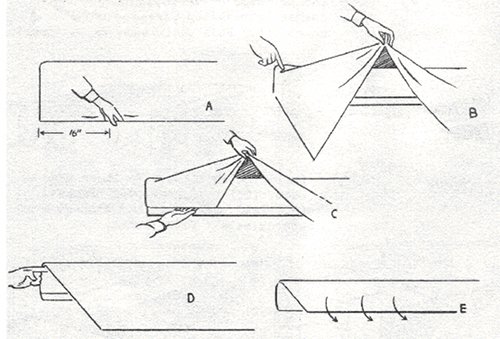
Hospital Corner how-to stolen from the Art of Manliness

It was April 1st, many years ago. My mother had just left town without us, which never happened. I can’t recall where she was headed or why; I only remember going up to my room and noticing that something felt distinctly out of place.

Granted, my room was a perennial disaster, but my bed was a different story; I made that thing with the precision of a watchmaker.  I pulled the sheets and blankets into crisp hospital corners, relentlessly smoothing each layer.  I folded the top of the bedspread back and over a perfectly fluffed pillow, so not a single peek of the sheets was visible.

The bedspread itself was covered with the names of tourist destinations I had never visited, arranged in a step and repeat pattern, white on blue.  Miami.  Palm Beach.  Orlando.  San Antonio.  Miami.  Palm Beach. Orlando. You get the idea. For the final touch, I would place a little rectangular pillow at a 45-degree angle, with two opposing corners pointing at a couple of Miamis.

Perhaps this was a byproduct of all the years I had to sleep on the daybed. I’ve softened a little, over the years, but I still remake the bed when my husband is not looking.

On this particular day, however, one corner of the throw pillow did not point to Miami and, glancing at the calendar, I knew there was trouble. Sure enough, someone had short-sheeted my bed. Without a word, I quickly and quietly remade it, waiting eagerly for evening.

When my father tucked me in that night, I made a bit of a show crawling in and stretching my legs with a yawn.  He eyed me suspiciously.  “Anything wrong?” he asked.  No, no.  Just happy to be in bed.  “Really?  Everything is OK?”  That’s when I learned that my mother had nearly missed her flight cooking up that little prank.  Ah, sweet victory.

The most memorable April Fools’ Day from childhood, however, involved my brother and me tormenting our sister. Thanks to his music pedagogy class, the day started with a harrowing early-morning bassoon solo/wake-up call—is there any other kind?– followed by my offering her breakfast in bed, which I promptly tossed on top of her.

That got her up.

As she began her morning regimen, we headed down to the kitchen.

Lord knows how we came up with the idea, but we decided to make a concoction that resembled dog vomit.  We filled the blender with peanut butter, yellow food coloring, raw oats, and a variety of other edible items.  The result was surprisingly lifelike.  Frankly, we were all unfortunate experts on the appropriate color and consistency, since our dog was prone to eat and upchuck just about anything from inside of a garbage can or under a rock.  I have even seen her enthusiastically lap it up and repeat.

Vomiting Dog 00 by eoioje from reverent.org

We put a generous helping of this lumpy, gooey treat on a small piece of saran wrap, and set it on the carpet in my sister’s room.

“Oh, man!  That is disgusting!  Look what the dog did on your rug!”

We played it up, of course, nice and loud so the entire household was privy to our conversation.

My sister, already more than a little annoyed from the previous incidents, poked her head out of the bathroom, took a good look, and sighed.  “Do you think you guys could clean that up? Please?” She sounded a bit desperate, as I remember, and I wish I could say that I felt a twinge of guilt.

“Of course,” I said, ostensibly heading down for some cleaning supplies.

“Just a minute,” my brother said, suddenly serious.  “I’ve heard that dog vomit is very nutritious, and surprisingly tasty as well.”

I feigned surprise.  “Really? Is that true?”

“I know it sounds ridiculous,” he continued, “but I was just listening to NPR, and a nutritional scientist was on the program discussing potential benefits of eating the regurgitated meals of domesticated animals.”

We debated for a while, after which I acquiesced to try it, and the discussion evolved to determine the proper substrate.  We continued to deliberate as we went back down the stairs, rooting through the bread drawer and the corner cupboard of snacks.  Finally settling on a hearty slice of homemade whole wheat—not the pickle juice variety, thankfully, that’s a whole other family legend—we brought the bread upstairs with a napkin and a butter knife.

“Mom!”  my sister screeched.  “Do you KNOW what they are DOING?”

If I recall correctly, this was about the time that the Shaklee saleslady arrived.

You might think that common courtesy would dictate an end to our charade, but the possibility of a larger audience only egged us on.

“Wow.  Dog barf is surprisingly delicious!” I fairly yelled.  “But seriously, when we finish, which Shaklee product will best remove the stain and odor?”

My only regret is that I missed the expression on the faces in the living room, as Mrs. So and So pretended not to notice and continued to hawk her fine products.  I believe my mother did buy a bit more than intended that day, perhaps in an unspoken agreement to keep this story out of our town’s gossip circles.

The sad thing is, I’ve spent so much time reminiscing, I haven’t cooked up a decent prank to play on my own kids this year. And they don’t even have sheets to short under their duvets.

Any suggestions?

Déjà View

@2007 Beret Olsen
@2007 Beret Olsen

This is the story of abandoning my family for two and a half weeks one summer to do something ridiculously selfish and wonderful. It is also about gelato, meltdowns, memory, and déjà vu. Have I mentioned that already?

Here’s how it started. A photography professor of mine leaned across the aisle during a lecture. She told me that she was taking a group of students to Italy during the summer. “You should come,” she said.

I laughed a little hysterically, to the point where the exchange became awkward, and we tuned back to the lecture.

Up until then, I’d only slept away from my four-year-old two nights of her entire little life, and those were spent on the floor of a friend’s house a couple blocks away–clutching my phone all night, just in case. And I’d never been away from my two-year-old. I had to lay down with her for an hour or two every night to get her to settle and go to sleep. Though I had weaned her at 18 months, she had taken to digging in my belly button as a replacement soothing mechanism. She picked at me with her tiny talons until I bled. Scar tissue, it turns out, is surprisingly sensitive, but I wasn’t sure how to wean a child from belly-digging.

There are probably a few people reading this that will roll their eyes and mutter in that superior way about sleep training. In my defense, I did try it with the first child. After several unsuccessful attempts on my own, after reading a pile of helpful books, I finally hired a sleep consultant, and tried again. My child cried and cried and cried and cried. She did not let up for naps; she did not let up for nights. She would doze off occasionally, only to wake up ten minutes later and start again. I let her cry and cry until there was a hole in my heart the size of Saskatchewan. So after THIRTY DAYS, I gave up. I didn’t even bother to try with kid #2. Now, how was I going to leave my spouse alone with such a mess?

With all of this in mind, I mentioned the Italy trip to my husband, so he could have a good laugh as well.

“Maybe you should go,” he said.

Best not to ask twice.

Strangely, despite the enormity of the impending separation, I didn’t freak out right away. I had childcare issues to resolve, packing crises, film and equipment to procure, and a research paper due upon departure. I worried about all of that instead.

Then I got on the plane…and cried for a couple of hours straight. Not demure little teardrops, either, but swollen, hiccoughing, snotty, sobbing. My apologies to the bewildered man seated beside me. Eventually regaining composure, I spent the rest of the flight listening to language lessons and, undoubtedly, murmuring along with the patient Italian lady in my headphones. Again, apologies.

The first couple of days on the ground were a blur of disoriented jet lag, a breathless march from church after church to museum after museum. Honestly, all I really remember about Florence is the gelato. Limone. Pesca. Caffè. Cioccolato. Shop after shop, fresh fruit piled high atop the frozen tubs, a little melty on the sides from the summer heat. In between scoops, I was having an out of body experience with some really fabulous twenty-year-olds. I was completely untethered.

@2007 Beret Olsen
@2007 Beret Olsen

On day four, we headed off to a monastery in Tuscany, where the landscape did something wholly unexpected: it became familiar.

I had already seen this place, on coffee tables, in ads, in my dreams. It looked exactly like it was supposed to look, and I was unable to see it as a foreign place. Even as I was wandering this countryside for the first time, it was already a memory, part of the landscape of my psyche.

@2007 Beret Olsen
@2007 Beret Olsen

For days, I couldn’t make a picture because all of the photographs had already been made; making another would be superfluous.  I focused on the long, lazy dinners–completely unknown to the parents of small children–the carafes of house wine, the late night walks filled with fireflies, frogs, and stars. I focused on the warm camaraderie of young strangers, who asked questions such as, “What is childbirth like?” “What are your irrational fears?” “Who do you secretly, shamefully lust after?” Or, “If you had to eat someone here, who would it be?” Those questions don’t often come up at pre-school potlucks. It felt so good to contemplate anything besides bowel movements, discipline, and sleep deprivation.

Since I would never forgive myself if I went home empty camera’d, I figured it was time to shoot something. And because I couldn’t make a new picture of the landscape, I tried instead to make pictures that looked like what I could see in my head. I attempted to capture on film my memories that were not really memories, that were not really mine.

@2007 Beret Olsen
@2007 Beret Olsen

After I returned to the States, I stumbled upon a passage that put this sensation into words:

“The very colors of the place had seeped into my blood: just as Hampden, in subsequent years, would always present itself immediately to my imagination in a confused whirl of white and green and red, so the country house first appeared as a glorious blur of watercolors, of ivory and lapis blue, chestnut and burnt orange and gold, separating only gradually into the boundaries of remembered objects:  the house, the sky, the maple trees. Even that day, there on the porch…it had the quality of a memory…” excerpted from The Secret History, by Donna Tartt

@2007 Beret Olsen
@2007 Beret Olsen

A very belated thank you to those of you who made that trip possible. I had a strange and wonderful time.

How a kid not really called Larry and his Top Secret notebook saved me from sixth grade

@2013 Beret Olsen
@2013 Beret Olsen

I loved school at first, back when it was okay to pay attention and know the answers. My mother worked in the school library, so after dismissal I would stay and help her re-shelve books, repair them, or–best of all–cover the new paperbacks with clear contact paper. If her work kept her later still, I could curl up on the carpet next to the hum of the fish tank, and happily devour any book that caught my eye.

Midway through third grade I got my vision checked. It was bad news—not too surprising for a bookworm.

My first pair of glasses had gold metal frames that were squashed into two little hexagons, and filled with already embarrassingly thick lenses. When I put them on, suddenly everyone else saw me clearly. They began to notice my dated hand-me-downs, my awkwardness, my skinny legs.  I started to hear whispers about birthday parties to which I was not invited, and once-good friends meandered away at recess. Those that didn’t, stole my hat and buried it, or worse, called me “Miss Mature.” My social circle slowly dwindled to one friend who insisted we play Dog, galloping up and down the stairs of her house on all fours. I appreciated her loyalty, but found her game babyish and tiresome.

Meanwhile, I tried to do well academically while flying under the social radar. I just wanted to survive and move on to junior high.

Then, in sixth grade, Mrs. Crouch sat me next to a kid I’ll call Larry.

Larry was on the scrawny side, and pale as a potato chip like me, but there the resemblance ended. As class clown, he had lots of charisma and loads of friends, but no desire to do anything but ‘get by’ academically. Larry had little time for things like geometry and state reports because he was busy with his super top-secret notebook. He carried it everywhere: a tiny red spiral-bound steno, which he filled with juicy details about the girls he liked, and then tucked in his back pocket for safekeeping. At recess, the popular girls would speculate about which of them had made his list, and what he might say about each one.

Clearly, he and I could not have been more different. The bizarre thing was, Larry and I got on spectacularly well.

For one thing, he was damn funny. I recall the giddy joy of watching the faces he made behind Mrs. Crouch’s back, and hearing him parrot her most annoying remonstrations.  I suspect we would not have gotten on so well if we had had a more palatable teacher.

“Who belongs to this ink pen??!!” she barked, waving it in our faces.

“Do not wipe your nose waste under the desk!”

Mrs. Crouch had a very prominent, pointy nose, which went well with her daily barrage of tedious teacher speak. She constantly lamented our lack of respect, and lectured endlessly about how much time we wasted messing about in line. We would all have to miss recess if one person spoke, or burped, or snuck a drink on the way to the music room.

Listening to her drone on and on seemed like the real time-waster to us.

Larry and I began to tune her out and do our own thing; we became allies.

Perhaps because I had no one to tell, Larry showed me his super top-secret notebook of girls, something he hadn’t even shown his closest friends. I found out that he liked Teresa because of her strong legs and perky boobs. He liked Becky for her great dimply smile and her athletic ability. Bethany had a tight little butt and a great sense of humor. Page after page of hormone-dosed, haiku-like lists of infatuation. In all, there were about fifteen girls for whom he pined, but not one would he ask out, not in a million years. I’m still not sure why.

When we would get caught discussing his notes, Mrs. Crouch would say, “What are you doing? Making a date for tomorrow??” And then she would laugh at our discomfort and embarrassment.

Resentment grew.

Larry and I started a new notebook: “The 50 Things We Hate Most about Mrs. Crouch.”

  1. Her sensible shoes.
  2. The way she calls pens “ink pens.” Is there some other kind?
  3. ??

I wish I could remember the rest. All I remember is how great it felt to retaliate with a pencil and paper. We never made it to fifty, of course. She wasn’t that bad.

The last month of school, Larry’s good friend Kenneth was seated in front of us. Sometimes he chatted and goofed around with Larry, but the bulk of his free time was reserved for making my life miserable.

He would poke me with his pencil.

“Miss Mature,” he said repeatedly, trying to get a rise out of me. I would pretend to be engrossed in my work, and then roll my eyes at Larry when he wasn’t looking. He would shrug. I knew where his alliances lay, and I understood.

Eventually Kenneth would tire of that game, though. Turning back around, he would tip his chair slowly, slowly, until his greasy head rested on my desk. I could no longer pretend to do my work.

“Ah! Miss Mature! Your desk is sooooo comfy,” he cooed.

Strangely, Mrs. Crouch never seemed to witness his egregiously annoying behavior; for once I would have appreciated one of her mind-numbing lectures. At least he would have had to sit up.

One day, as Kenneth started to tip back, Larry stared at the back of his head thoughtfully. Suddenly, he grabbed my desk and slid it back just enough so that Kenneth crashed backward onto the floor.

Since he didn’t crack his head open, I can safely call that the best day of fourth, fifth and sixth grade combined. What’s more, Kenneth never rolled his head on my desk again, not even when we had to sit next to each other in junior high.

Eventually Larry gave me his notebooks for safekeeping, and I’ll probably find them when I dig through the closets at my parents’ house. It would be hilarious to re-read them, but I don’t really need them anymore; just reminiscing about them does the job. Thanks Larry, wherever you are.