“Sometimes I think you have to march right in and demand your rights, even if you don’t know what your rights are, or who the person is you’re talking to. Then, on the way out, slam the door.” – Jack Handey
For years I laughed at Jack Handey’s inane musings on Saturday Night Live, all the while thinking he was a character created for the show.
Not so; he’s real.
Not only does he live and breathe; some people take him semi-seriously. Recently, a friend forwarded an essay to me from the New YorkTimes: “And Now, Deep Thoughts About ‘Deep Thoughts.‘” In it, Kathleen Rooney asserts that Jack Handey is the perfect exemplar of contemporary poetic thought. Say what?
I swear I’m not making this up. It’s an engaging read, and the comments are worth a squiz as well (including this one: “I googled myself and decided this is not a person I want to know.” ).
Though I understand the author’s point, I agree with one of her critics. The author has conflated wit and poetry, which–though not mutually exclusive–are definitely not the same thing.
Here’s what I do know, though. Every time I read one particular sentence of his, I think about how absolutely flawless it is:
“The face of a child can say it all, especially the mouth part of the face.”
I got up at 5:20 today, and haven’t stopped since, so I would rather poke my eyes out with a hot stick than sit down and try to write something right now.
You might also be wishing that I never, ever pledged to post daily for thirty days straight; apologies in advance.
In the absence of any other coherent thought, I have decided to pass along a valuable piece of information that I received a couple of days ago.
I had mentioned a dead hamster in a post–“Hamsty”–who was well-photographed before we laid him to rest in a Hamsty-sized sleepsack, with a tiny pillow, in a tiny coffin.
It was tasteful and surprisingly moving for a rodent funeral.
I have recently been informed as to how real Vikings send their dead pets to Valhalla, however:
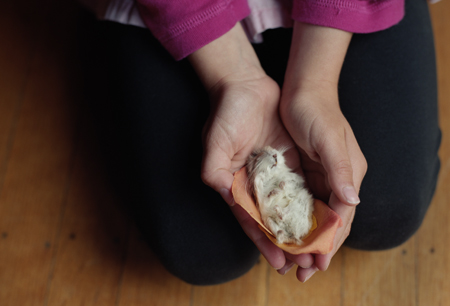
Not long ago, an acquaintance walked into my entryway and stared at a photograph I had taken of my daughter holding her pet hamster. “Is that guy dead?” she asked me.
I suddenly felt very, very uncomfortable.
“Uh, yeah,” I said, unsure whether to feel embarrassed or ashamed. I picked both.
She looked at it for a long, uncomfortable moment before announcing: “That is sooooo Scandinavian.”
I had no idea what she meant, but since I’m 100% Norwegian, I figured she might be on to something. It was time to investigate.
I have relatives who swim daily in the ocean off the coast of Oslo, and run around their mountain cabin naked in the middle of winter–no doubt after a good dose of Aquavit. I can assure you that this is not what it was like for me in my childhood home. My parents are the sort that drink a thimble-full of red wine for medicinal reasons, and comport themselves in a dignified manner at all times. I think I’ve heard them raise their voices three or four times in my entire life.
Growing up, I was carted off to Junior Sons of Norway on Saturdays, where I learned the Norwegian national anthem–which I can be easily enticed to sing, with great enthusiasm–and Min Hatt, Den Har Tre Kanter (My Hat, It Has Three Corners, a deep and lyrical song, as you ca imagine). I was fed Lutefisk (fish soaked in lye) once a year, and taught to say grace in Norwegian whenever we excavated the dining room table and broke out the china.
I associate my ethnic roots with a palate-numbing dose of pickled herring, passed like treasure in a tiny, silver-rimmed dish at Christmas dinner. In fact, Christmas arrived with a long list of Scandinavian things I can’t and/or won’t eat: Swedish meatballs, fruit soup, lefse, herring, rice pudding. (Sorry, Mom. I love you.) My mother would hide an almond in the rice pudding, and whoever found it got an extra present on Christmas Eve. I loved this tradition, but despised rice pudding. I would shove a spoonful around on my plate, and if I couldn’t find a nut, try to reorganize it in a polite way which simulated ingesting an honorable amount.
But I think it goes much deeper. Those Norwegian immigrants were unflinching, hardworking, stoic powerhouses in the face of the adversity and desolation of the Plains. In fact, my name was plucked from Ole Rolvaag’s Giants in the Earth, a chronicle of Norwegian immigrants in the Midwest. I have visited his house multiple times, read articles, and listened attentively to stories about him, but I have never, ever been able to make myself read the book. Here’s why: from Wikipedia, “The novel depicts snow storms, locusts, poverty, hunger, loneliness, homesickness, the difficulty of fitting into a new culture, and the estrangement of immigrant children who grow up in a new land.” What’s more, I heard my namesake has a paralyzing case agoraphobia.
“Is it true Beret goes crazy in the book?” I asked my mother. “Why would you name me after a character like that?”
There was a quiet pause.
“She really pulls it together in the second book,” my mother said, finally.
In the very back of my sister’s closet was a tall, quilted dress bag. It was made of pale pink plastic and filled with my mother’s fancy dresses.
One was a Dutch-blue satin dress she had worn in her best friend’s wedding. It was off-the-shoulder, tea-length, in a simple and flattering style I don’t associate with bridesmaids’ gowns. I loved the feel of the fabric as the flared skirt swayed and brushed against my legs.
There was a floor-length pink gown that had been chopped and altered, once for my sister on Halloween, and once for me when I played Glinda in the fifth grade musical. It had a scratchy layer of tulle over the top, which was uncomfortable, but extra glamorous.
There were several more dresses, but the only other I vividly recall was the one my mother had made for a tea dance in high school. It had a brocade bodice and a wine-colored satin skirt. It was simply divine. That one I put on repeatedly.
If no one was around, I liked to sneak a pair of white gloves from my her bedside table, the ones with a tiny flower of seed beads on each wrist and an impossibly small button.
Then I might poke through her jewelry drawer, the bottom of which was covered with a flat of egg carton material, so each item could be investigated and laid reverently back into its soft gray cup. I might try on everything, but I always ended up with a single strand of pearls from my Grandmother.
One day in high school–nearly a decade since I had played dress up–I happened upon the dress bag in the closet, and decided to try on that tea dance dress once more.
What happened next is difficult to articulate. Each seam fell exactly into place and the hemline was perfect. I stared in the mirror and was overwhelmed by a creepy sensation. It was uncanny. Not only had my mother made the dress, and tailored it perfectly to her frame, she had made me, too. Suddenly the concept of genetics was no longer textbook essays and double helix diagrams. It was concrete and intensely physical. She made me.
I know she had help; I get it. But it wouldn’t have been the same to try on my father’s trousers.
Most times, I find mammograms uncomfortable but otherwise forgettable; today was an exception.
Today, both of my important parts were tender, and in retrospect, this seems like an excellent cue to call and reschedule…no matter how many times I might have done so previously.
After flashing the waiting room–
No, no. Flashing is not the right verb. Flashing suggests a fleeting instance, rather than sitting around for a good ten minutes before noticing a disconcerting breeze.
Stupid gowns.
After entertaining the waiting room, a short, thick woman barked my name with a distinctly Germanic accent. I could tell she meant business.
“First time?”
“No.”
I scurried behind her into a glorified closet, and once again stood in awe of the fridge-sized vise. For the uninitiated, this contraption does not gently mold your melons into soft patty shapes; rather, it unceremoniously clamps them into horizontal ping pong paddles. If I could see what was going on, perhaps I would be impressed: “Say, I could use those as serving platters, or a shelf for my bags when using the restroom.”
Despite the fact that the technicians are always female, mammograms also involve a lot of man-handling. Consequently, I didn’t fully realize the impending danger when she yanked my right boob into the machine and began pressing the foot lever to crank it shut. In fact, I didn’t really start worrying until I heard myself scream.
“Sorry, sorry, sorry,” she said, crisply.
Her delivery was not at all convincing, especially since she continued to stomp enthusiastically on the lever well past the point when I stopped breathing and the room started to go black.
Repeat that three more times. She said a few other things to me in the process, but every time she opened her mouth it sounded like: “Vee haff vays uff mekking you tok.” Believe me, if I had any big secrets, this would be a quick way to pry them out of me. I’d spill yours, too, come to think of it.
I suppose I’ll be back again next year, but if the boob crusher calls my name, I’ll feign illness and reschedule.
***
I wonder, now, what propels a person into this sadistic line of work, anyway?
Summers were the antidote
For wounds inflicted by the words and silence
Of the cruelest people I know:
Children,
Blissfully unaware of empathy or mercy.
I donned a skirt I’d never worn–
Ill-fitting, handmade, and hand-me-downed–
Perhaps an attempt to play a different role in this year’s performance.
It was inappropriate armor for my return to battle.
On the front porch,
My father tried to coax a smile,
Or at least turn my sullen gaze toward the camera.
From there, I walked alone,
Clutching a bag lunch and a binder
Too grown to admit fear
Past the smokers
And knots of cool kids
To the front doors.
The moment you announce that the free ride is over, that this parasite had better get out of your uterus, a tiny tyrant emerges, and you wonder if you might possibly cram it back inside, just to secure a few more moments of sanity and solitude.
This wee, adorable creature demands all of your time, attention, energy, and soul. There is nothing and no one else that matters as much. This is why cherished friendships shrivel, marriages are raked over the coals, and newish parents become unbearable. You are suddenly up at all hours of the day and night. You cannot finish a sentence or focus on anything uttered by an adult. Worst of all, the things you smirked and said you would never do, you see and hear yourself doing without apology.
A little shame, perhaps, but no apology.
The boundaries blend. It is not possible to distinguish where you end and where the child begins. You anticipate their needs, and punish yourself when you can’t identify or remedy a discomfort. They are the center of your universe.
And they grow.
Imagine that you are beside yourself because you are stuck playing Barbies yet again. Each minute stretches into an eternity. You can feel yourself devolving, while politically astute essays you composed in a past life unwrite themselves in your head. You parade a stupid piece of malformed plastic around, babbling the required perky gibberish–all while secretly wondering, “what is the meaning of my life?”
And then, the very next time the Barbies come out from under the bed, just as you are mentally muttering obscenities, your daughter turns to you, and from her lips come the most surprising news.
“Mom.” Accompanying eyeroll. “We are playing in here. Please shut the door.”
A lump forms in your throat. You were already gearing up to feel resentful for the next 45 minutes. What are you supposed to do now?
A mini-post in honor of NaBloPoMo: National Blog Posting Month.
NaNoWriMo is clearly out of my league this year, but I’m determined to use the energy surrounding the event to squeeze a little writing out of my keyboard on a daily basis.
Before traveling to Japan last summer, my ten-year-old taught me six phrases:
Toire wa doko desuka? Where’s the bathroom?
Sumimasen. Sorry/excuse me.
Arigato gozaimashita. Thank you so much.
Gochiso-sama deshita! It has been a feast.
Ohaiyo gozaimasu/konnichiwa/konbanwa. Good morning/good day/good evening.
O-kanjo o onigai shimasu. May I please have the check?
But if I had to boil it down to the bare essentials, the top three would have done the job.
While in Tokyo, we had lunch with my brother’s in-laws, wandering afterward to Meiji Jingu, where he was married many years ago. Together, we pleasantly whiled away three hours, pointing, gesturing, smiling, looking at photos, exchanging gifts. It is astonishing how few words can communicate so much.
I suppose we couldn’t discuss the fine points of Kierkegaard’s Upbuilding Discourses, but I couldn’t do that in any language. I’m not advocating for monolingualism–so much of our history and culture is embedded in our words and silences. I am merely pointing out that speaking is not the same as communicating, and listening goes deeper than hearing words.




 Bad Parenting 101