In the very back of my sister’s closet was a tall, quilted dress bag. It was made of pale pink plastic and filled with my mother’s fancy dresses.
One was a Dutch-blue satin dress she had worn in her best friend’s wedding. It was off-the-shoulder, tea-length, in a simple and flattering style I don’t associate with bridesmaids’ gowns. I loved the feel of the fabric as the flared skirt swayed and brushed against my legs.
There was a floor-length pink gown that had been chopped and altered, once for my sister on Halloween, and once for me when I played Glinda in the fifth grade musical. It had a scratchy layer of tulle over the top, which was uncomfortable, but extra glamorous.
There were several more dresses, but the only other I vividly recall was the one my mother had made for a tea dance in high school. It had a brocade bodice and a wine-colored satin skirt. It was simply divine. That one I put on repeatedly.
If no one was around, I liked to sneak a pair of white gloves from my her bedside table, the ones with a tiny flower of seed beads on each wrist and an impossibly small button.
Then I might poke through her jewelry drawer, the bottom of which was covered with a flat of egg carton material, so each item could be investigated and laid reverently back into its soft gray cup. I might try on everything, but I always ended up with a single strand of pearls from my Grandmother.
One day in high school–nearly a decade since I had played dress up–I happened upon the dress bag in the closet, and decided to try on that tea dance dress once more.
What happened next is difficult to articulate. Each seam fell exactly into place and the hemline was perfect. I stared in the mirror and was overwhelmed by a creepy sensation. It was uncanny. Not only had my mother made the dress, and tailored it perfectly to her frame, she had made me, too. Suddenly the concept of genetics was no longer textbook essays and double helix diagrams. It was concrete and intensely physical. She made me.
I know she had help; I get it. But it wouldn’t have been the same to try on my father’s trousers.
The moment you announce that the free ride is over, that this parasite had better get out of your uterus, a tiny tyrant emerges, and you wonder if you might possibly cram it back inside, just to secure a few more moments of sanity and solitude.
This wee, adorable creature demands all of your time, attention, energy, and soul. There is nothing and no one else that matters as much. This is why cherished friendships shrivel, marriages are raked over the coals, and newish parents become unbearable. You are suddenly up at all hours of the day and night. You cannot finish a sentence or focus on anything uttered by an adult. Worst of all, the things you smirked and said you would never do, you see and hear yourself doing without apology.
A little shame, perhaps, but no apology.
The boundaries blend. It is not possible to distinguish where you end and where the child begins. You anticipate their needs, and punish yourself when you can’t identify or remedy a discomfort. They are the center of your universe.
And they grow.
Imagine that you are beside yourself because you are stuck playing Barbies yet again. Each minute stretches into an eternity. You can feel yourself devolving, while politically astute essays you composed in a past life unwrite themselves in your head. You parade a stupid piece of malformed plastic around, babbling the required perky gibberish–all while secretly wondering, “what is the meaning of my life?”
And then, the very next time the Barbies come out from under the bed, just as you are mentally muttering obscenities, your daughter turns to you, and from her lips come the most surprising news.
“Mom.” Accompanying eyeroll. “We are playing in here. Please shut the door.”
A lump forms in your throat. You were already gearing up to feel resentful for the next 45 minutes. What are you supposed to do now?
I wore the same fairy costume for four years running.
My getup consisted of someone’s worn and baggy blue dress, a cardboard tiara, and a star covered with Reynolds’ Wrap and taped to a piece of dowel.
Back then, the time change came earlier in the Fall, so it was nice and dark early on the big night. Unfortunately, it was also ridiculously cold, and because my parents loved me, I had to wear a coat covering my costume. They probably did not recognize this as the great disappointment it was, especially since everyone had seen my costume numerous times already.
I’m pretty certain my sister was asked to look after me, but what junior high student wants a baby sister tagging along with her posse after dark? Consequently, I had free reign of the neighborhood from a staggeringly early age, and my candy was only stolen once. No other tragedy befell me.
I would wander, giddy and anxious, mesmerized both by the boisterous clumps of people I wasn’t sure I knew, and by my paper bag, swelling with forbidden sweets. I would take them home and count them, chart them, graph them. I would eat two or three pieces, then squirrel the rest away, doling it out so it would last until Easter–the next time we got a statistically significant dose of sugar.
Once I got a bit older, I branched out and tried new costumes, always outdone by the girl who lived catty-corner from us. How did she predict my costume three years in a row? My mummy costume was made out of an old sheet torn into strips, and held together by an array of safety pins. It drooped and exposed my sweat pants in embarrassing patches. Julie’s father was a doctor, however, so hers was made out of surgical wrapping that clung magically to her gloating face.
Multiply that stinging feeling by all three years. I suppose I would have developed lingering unpleasant feelings about the holiday were it not for the Halloween party we had in our basement the year I turned eleven.
In my opinion, all basements are inherently cold and creepy, and ours was no exception. Scariest of all was the storage room, with concrete walls and floors, and rickety metal shelving loaded with spider webs and long-forgotten boxes. We shoved a few things out of the way so we could guide blindfolded kids one at a time into its clutches.
Perched here and there on the shelves were a variety of bowls into which we plunged their unseeing hands. One held eyeballs, or peeled grapes, and another brains, which was clammy cooked spaghetti.
Things got weirder.
Once a year, my parents purchased a side of beef, which was cut and meticulously wrapped and nestled in the extra fridge in the basement–the one without a handle, that we wrenched open with a dish towel and a finely choreographed hip maneuver. We had no shortage of strange cow parts in the basement freezer, so we thawed a variety of organs to fill the other bowls.
Given the location and ingredients, I suspect that our haunted house would have been just as creepy without the blindfold. And though this may reflect poorly on me, I reveled in the yelps and screams of our guests, and later, their wide-eyed wonder when we revealed the bowls’ actual contents. I think most of them had hoped that what we passed off as a heart might not really be a heart.
The piece de résistance of the evening was the Ghost Cake with Flaming Eyes, however. I remember so clearly that feeling of triumph when we turned out the lights again and lit the eyes.
Ever since that night, Halloween has been my favorite holiday.
Read this yesterday, and it snagged in my consciousness. Both sides speak well and truthfully. I think we have conflated strength and power with their cultural definitions, and it is helpful to step back and rethink. I had trouble posting this, though, and couldn’t get the youtube video to embed properly. The link to the poem’s performance is in there, and definitely worth a watch. It also provides the context for Rarasaur’s essay.
I listened to your poem last month, for the first time. I know, I’m a little late to the party. Your performance was in April.
It was sent my way via an article that said it explained the plight of women, who sacrifice for men. I’ll be honest. Activism that suggests someone is behind because someone else is ahead bothers me. Feminism along those lines is what makes me reject the label with a ferocity that would surprise most people– given that I am the “breadwinner” of my home, and in most ways live the feminist ideal. This type of activism suffocates me, and angers me, and limits my brothers and sisters alike– and though I didn’t intend to– I listened to that poem without a beginner’s mind. I sought offense, and I found it– even though your poem was great, and your performance was brilliant.
I wrote my own slam poetry response. The first parodied yours. Yours played on the idea that men of age are often significantly larger than their wives. Mine played off the idea that women live longer.
“Men of my family have been shaving away seconds of life, for women, for decades.”
The second poem I wrote was structured like yours as well, but along the way led into the idea that my mother is the strongest person I know.
This made me reassess my reaction to your poem, and create an alternate possibility that I’d like to share with you.
You see, I’m nearly 30, and it was just a smidge over a decade ago that I would have scoffed at the idea of my mother possessing any strength at all.
I could barely look her in the eye for a whole year of my teens. She seemed like such a waste– this stunning, genius of a woman– reduced to a mother with a near broken back, working all the time for other people’s desires. I don’t know if she’s ever slept more than 8 hours in a row. As soon as she gains something, she gives it away– whether it was space, or knowledge, or money. Every time I saw her, I feared the same would happen to me.
I worried that I had been taught to drop my achievements at a moment’s notice– in the name of handcuffs created to hold women back– just because of my mom’s dedication to those same restrictions. I was worried that I was born into a kind of slavery.
And then there was the car accident.
You see, I have 5 brothers and sisters– so not everyone fits in one car. My big brother had the baby seat, so he was following behind us with my baby sister. The rest of us were with my mom. It was a dark night and we were driving back from dropping my father at the airport– down a fast-moving, icy highway. There were black ice warnings out, and I was in the front seat because I could almost always spot the slippery stuff.
It started to snow, in torrents hard enough to push at the car, and then from the side mirror, I saw it. My brother’s car spun out of control and rolled off the road and down a hill. I screamed his name, and my mom– who witnessed the same thing– put her hand out on mine. She sang a song, to keep the kids in the back of the car asleep, and drove steadily on until there was a place to safely stop. There were tears running down her face, but her voice was clear. She parked the car on the side, put me in charge, took off her 2 inch heels, and walked into the dark snowstorm barefoot– bravely towards what could have been the mere bodies of her children.
I’m not sure on the details, but my brother’s car was started again, and pushed up the hill– and both he and my baby sister were fine.
When I saw my mom finally walking back to me, hours later, the sun was coming up– she was soaked through, and covered in dirt and blood. She was holding her children– and a stranger– and she was smiling.
It occurred to me then that a passerbyer might see her as a woman down on her luck, in a position of weakness– but it was the most invulnerable thing I had ever seen. The sort of strength many people never get the chance to witness in a lifetime.
It sounds like you might have blessed by the benefit of an equally dedicated mother.
A dedication to sacrificing is such a brittle concept, and can look a lot like weakness– like late night trips to the fridge for yogurt and wine from a measuring cup– but it is more powerful than words or swords.
I of course do not know your specific situation, but the next time you see her tucked away in a small space, consider the possibility that it is because she doesn’t need much space to live the life of her dreams, and that she has faith in your ability to do something brilliant with the extra room.
And next time you see worn hands, or a tired back, consider the idea that it is because she has made a priority out of carrying those who cannot move forward themselves.
When the people around her seem to grow at the cost of her loss, lookagain. Their expansion is her battle cry. She is victorious through nurture and sacrifice.
It is a power connected to the heart of the universe. A strength that fueled a nun to care for lepers, and prompted a man to share a dream of equality. It echoes through every positive change humans have ever seen, and grows every day under the protection of guardians like our moms.
Does that really sound like shrinking to you? Because to me it sounds like something big enough to expand its way right past the hemmed edges of the galaxy.
I realize now that I wasn’t worried that I would becomemy mother. I was worried that I would never become the sort of person worth the sacrifices she made.
Snaps to you for showing off your power. I hope you know that your mom is right to give to you: you are worthy of all the good this world has to offer. If you can accept that truth, I think you’ll find you’ll stop apologizing for empowerment. Just do good with it.
With love from a big sister born of the same big power,
Rara
_______________________________
I probably won’t respond to any comments about feminism, because it’s an issue that goes much deeper than my type of blog– but as always, you’re welcome to share your thoughts as long as you play nice. This post has seen the light of day due to a Daily Post prompt, asking about the post I was most nervous to publish, and what it was like to set it free. I’ll get back to you on that last part of the question depending on how scary my comment section ends up being.
Have you ever driven on black ice? It’s one of my top fears, even before this night.
There are plenty of cultural oddities for a whitey round-eye like me visiting Japan.
For starters:
Japanese Vending Machines.
Did you know Japan is about 500 degrees in the summer? Plus 99% humidity? Me neither. It’s so tidy and cool in the guidebooks. Everyone looks all nifty and suited up and un-sweaty-like. Have they photoshopped all of the melting tourists out of the pictures?
Luckily, every ten yards or so there stands a vending machine of happiness.
I’ve seen vending machines before, obviously, but not like these. They are tempting. They are sassy. And they dispense whatever you might desire: juice, milk, towels, ice cream, sweet iced coffee labeled BOSS. You can say whatever you need to say to that boss for 120 yen. That boss has been canned.
A great many vending machines are chock full of beer. Due to circumstances beyond my control, such nectar of the gods is strictly verboten. I struggled to avoid eye contact with the Asahi machines that cropped up on every other block. Given the weather, a cold beer looked damned tasty, even through the shower of perspiration raining down my face.
Oh, well. The spouse could always roll his cold can on the back of my neck.
Japanese Toilets.
What to do? From thejapans.files.wordpress.com
It was a little alarming the first time I sat down and perused a toilet control panel, too terrified to push anything. What invasive and embarrassing activity might commence? It is a vulnerable feeling to bare your behind and then submit it to the great unknown.
My two girls were not so tentative. I heard them locked in a stall, screaming and shrieking with laughter. Lord knows what was going on in there, so I retreated to the hallway, cheeks a bit flushed.
One finally emerged, breathless. “Did you push the button with a musical note?” she asked. Turns out, it had played the Star Wars theme. If the line had been shorter, I might have gone back to give it a go.
Sadly, in most restrooms, the music button only makes a loud flushing sound, but now that the note button seemed safe, I decided to step-up my exploration.
What I discovered is that many of the options are surprisingly refreshing. In fact, it was disappointing to arrive back in the States and remember that our lackluster commodes do nothing besides give the ol’ heave-ho to a variety of deposits.
And now…a quick word about the seat heater. It might be a nice feature in certain specific circumstances. Like, in the middle of winter…in your own home. But it was downright lurky to sit on a hot public toilet. It made me think of bacteria multiplying, and about the last pair of bare buttocks that had rested on the very same spot.
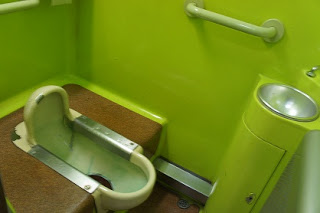
You may be imagining the pit on the ground, which would not be so bad. No. On trains, the pits are at commode level. You have to step a couple feet off the ground and clutch the safety rail for dear life, trying to maneuver your pants to the ankle area with your free hand. Alternately, you can use your free hand to tuck your skirt into your armpit.
Who decided it was a good idea to dangle your hind-side over a hole while hurtling through the countryside at 240 miles per hour? Avoid. Trust me.
Toilet Slippers.
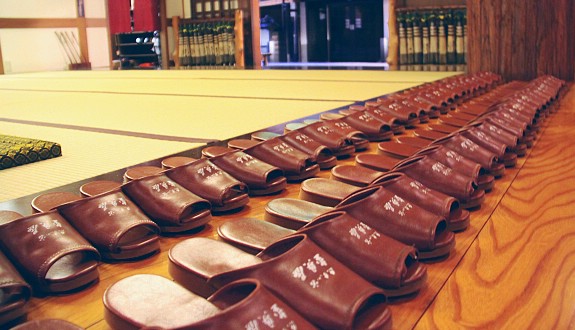
Regular slippers, from japan-guide.com
Never step on tatami mats while wearing shoes. You probably know that.
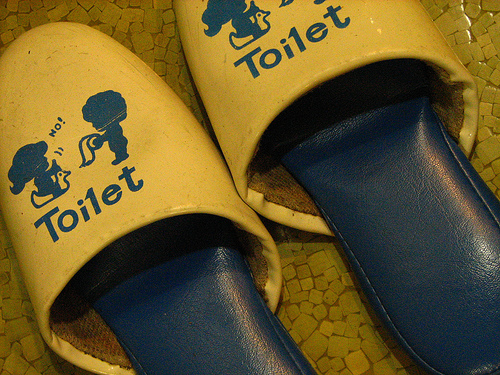
When you get to the restroom, you have to take off those REGULAR slippers and change into your TOILET SLIPPERS. God forbid you get your slippers confused.
When all this takes place in your postage-stamp sized hotel room, absurdity reigns. Imagine opening the door to your teeny tiny room, removing your shoes to put on your regular slippers, shuffling eighteen inches to the bathroom door and changing your footwear yet again.
Also, it felt ridiculous to have the word “toilet” written on my feet. At least dogs can’t read.
Pickles.
Pickles, pickles, pickles.
What is it with pickles?
Breakfast, lunch, and dinner. More pickles. Different pickles. Pickles as palate cleanser, as condiment, as garnish, as digestive.
It’s like the Eskimos with their snow, except you have to eat it.
Cat Cafés.
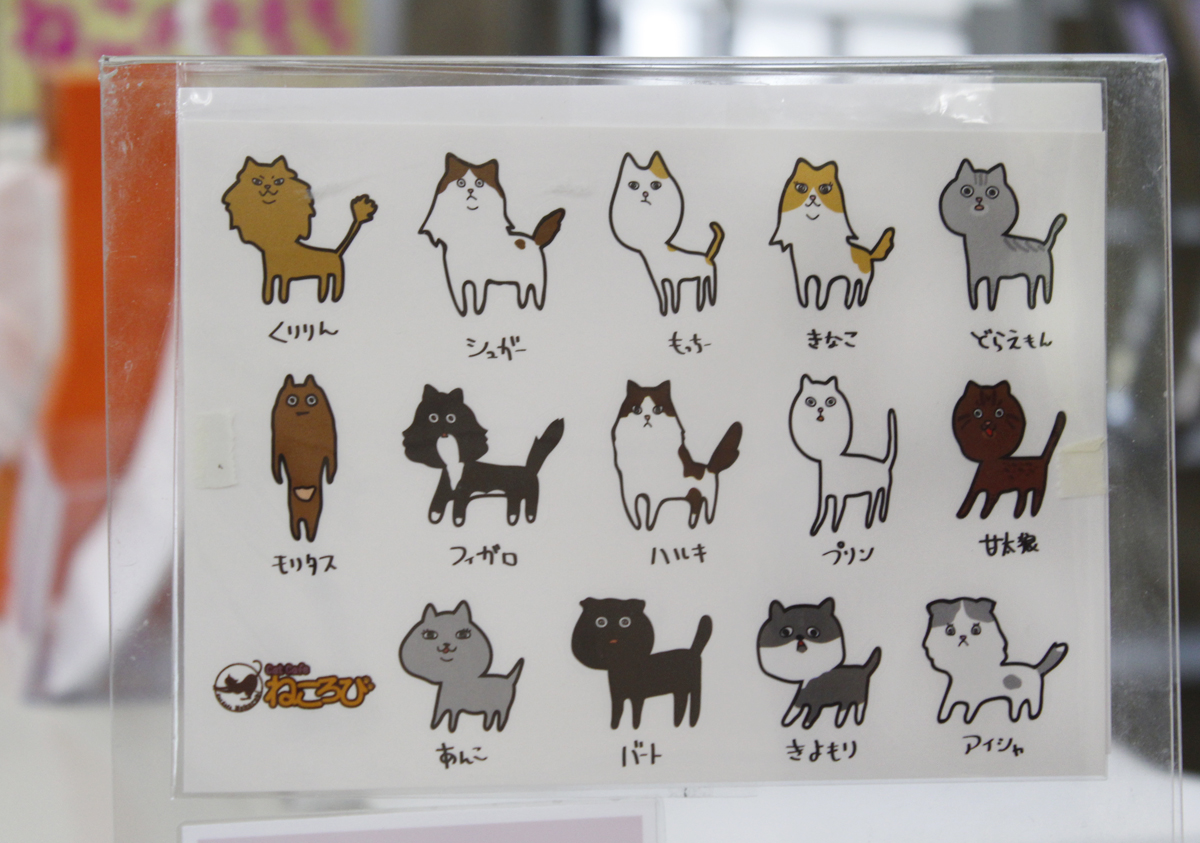
Menu of cats the day we visited.
Traveling with children means you can’t simply do what the grown ups feel like doing all day everyday. In order to prevent a terrible snit–or worse, mutiny–we had to mix in destinations and activities that would amuse our tiny tyrants. Since we were trying to avoid places like Tokyo Disney, however, we tried to find things that were uniquely Japanese.
About two thirds of the way through our trip, the girls got very homesick, and started waxing nostalgic about our beloved, neglected cat at home. Cat Café, here we come.
The first cat café started in Korea, followed shortly thereafter by one in Osaka, but the pet rental phenomenon really took root in Tokyo, where they have about 40 cat cafes. Since most apartments forbid pets, these places feed the need to find furry love and a little zen-like escape from the frenetic, crowded urban life. One can also find bunny bistros, dog cafes, and an occasional goat here and there, but cat lovers head to places like Nekorobi, in Ikebukuro.
This was a lovely respite for all of us, except the spouse, for whom one cat is definitely enough (if only barely tolerable). He amused himself around Ikebukuro, which is an interesting little pocket of Tokyo.
In case you are secretly judging me, this was not just a place for crazy cat ladies. People go there and play with cats, of course, but only when the cats are interested. Otherwise, people read, and sip coffee, and work, and do regular people activities.
Best of all, Nekorobi had fancy vending machines. They had cubbies and sci-fi toilets. They had regular slippers and bathroom slippers, bean bags, and wifi. And cats.
Plus, no pickles or pit toilets. Perfect.
Couldn’t read the menu, so I called this one Soul Patch. My fave.
A note from Beret: I wrote the preceding piece in response to a photo prompt posted on 100 word story. They post a new prompt each month…plus it’s chock full of amazing 100-word stories, as you might imagine.
By now, you’re probably familiar with the benefits of vacation. I don’t need to list them, do I?
If you’re not sure, you can seek help from a pile of sunkissed facebook friends, always slapping up photos of this or that paradise, regaling you with stories of fun, fun, fun, and going on like foodie wankers about every morsel that has touched their lips.
I love reading your posts, of course. That goes without saying.
I just got back from the trip of a lifetime, so once I have fully digested the experience, I’ll probably bore you with a post or two about how great it was. For now, I thought I’d remind you that vacation can have its drawbacks, too.
1. Jet lag is insufferable.
How is it that human beings have figured out how to clone a sheep, land on the moon, and sequence our genetic material, but no one has figured out how to avoid jet lag?
I try, though.
I have tried all kinds of homeopathic remedies, as well as a garden variety of pharmaceuticals. I have tried foregoing coffee a week in advance, or drinking it only at 4 pm. I have tried yoga, sleep hypnosis, and apps with gentle sounds and white noise. Last time I suffered from jet lag, I tried getting up in the middle of the night to write. This year, I am just lying in bed worrying about not sleeping.
2. Kids do not sleep well when traveling, either.
This is an understatement. I’m not sure I can talk about this without dropping a few choice words, but I should try since my mom has started reading my posts.
On our most recent trip, the eight-year-old completely forgot how to sleep like a regular person. First off, she couldn’t fall asleep. She whined and cried, and then cried harder because she felt guilty. “I’m so sorry, Mama,” she sniffled repeatedly.
“No one’s upset with you, sweetie,” I lied, trying hard to keep my tone light. “But it would be great if you could just lie still and be quiet.”
We plied her with Sleep Rescue and Calms Forté. We gave her chamomile tea and rubbed her back. We stroked her hair and whispered soothing things. After a couple of hours, she would drop off for about 45 minutes. Then, the sleepwalking commenced. And sleep shouting. It got to the point where I couldn’t doze off, no matter how exhausted, because I knew should she would scare the bejeezus out of me the second I relaxed. “Help! I can’t get out! Let me out! I NEED TO GET OUT OF HERE!” she yelled, pulling open drawers, banging against the walls and the door. That girl was constantly and desperately trying to escape.
“Not to be rude,” the ten-year-old finally piped up one night, “but could you possibly shut up so I could sleep?”
Did I mention that we were all busy not-sleeping in the same room for nineteen days?
3. You can still get sick.
For once, it wasn’t me, but it sounded pretty bad. The spouse got a sinus infection accompanied by a wracking cough and general malaise. Every time he laid down, he would start hacking like an emphysema patient, adding to the challenges mentioned in numbers one and two. Consequently, he burrowed into the hotel room in a semi-seated coma for several days. We didn’t completely desert him; we would stop by now and then to get updates on the progress of his plague.
“I just pulled out a rope of snot,” my spouse confided. I murmured something, but apparently did not communicate the proper awe. “Seriously. I was physically pulling it out of my nostrils, because it was too thick to blow.” OK, kids. Time to go.
4. Interesting cultural moments can be a bit painful.
Like when your child says, nice and loud, “How much is a million yen in human money?”
Sigh. Eight years of sensitivity training at home, all for naught.
5. There can be some alarming culinary challenges.
Make no mistake, I had some awesome meals. But in the interest of keeping an open mind, I made myself try a lot of things that were outside my teeny tiny comfort zone. Due to a variety of preferences and intolerances, plus general squeamishness, I am a pain in the neck at the table. This time I was going to surprise everyone, especially the brave spouse.
Kaiseki roughly translates from the Japanese to: “if you put a second mortgage on your house, the chef will serve fourteen courses you would never, ever order, then watch intently while you try to put it in your mouth without making a face.”
I ate a whole fish, pleading eyes, spine, fins, and all. It was gut-wrenching to make my teeth crush that little guy. Uni (sea urchin) appeared. It was terrifying. It looked like the jaundiced tongue of a ill-fated five-year-old. But I ate it. I also ate raw quail egg, fish jello, pickled everything except cucumbers, and quite a few things I simply could not identify.
R.I.P. Swimmy. If it is any consolation, I dunked your face in the mysterious green sauce so you would not have to stare at the back of my gullet on the way down.
Then a shot glass appeared, full of a clear, gooey viscous something–I believe the chef called it sea threads–complete with a raw octopus arm shoved in there. I hesitated. The spouse plunged fearlessly ahead, of course. I watched him toss back the shot and chew it for several long minutes, while fighting my gag reflex. I couldn’t do it.
Frankly, I’m a little disappointed in myself. Maybe it was fabulous.
6. Mother Nature has her own itinerary.
Evidently, we were staying at the foot of this mountain for four days:
I never saw it. I have a picture just like the one above except there is no mountain. And no sky. Just a big cloud of nothingness encompassing everything above 6 feet.
During this period of inclement weather, our hosts came down with strep throat. We babysat their kid and wished we knew of someplace to go–and how to get there. We did visit the supermarket several times, and ate at a place known affectionately as “the truck stop.” We visited a dirty little hot springs–complete with a vending machine of towels and a layer of sulphuric slime on everything–while the hosts slept in the car in the parking lot. Then they rallied and drove us around a bit, pointing out places we might have gone if they had been feeling well, or if the weather had been better.
Nice people, though. Really nice.
****
I have plenty of other misadventures to report, but now that we are nestled back in the damp, cold that Bay Area residents call “summer,” those memories are starting to fade. Pretty soon, all I’ll have left are the good ones, plus some lovely photos. Perhaps I’ll post them for everyone to admire.
@2012 Beret Olsen Last year, I was feeling so smug because I watered my orchid stick for six months, and it magically bloomed on Mothers’ Day. Sadly, this year it’s just a stick. Oh well. Happy Mother’s Day anyway.
One summer day in my early teens, my parents and I went on a long drive from our woodsy cabin to Lands’ End.
Though we had hoped for a sunny day on the coast, the fog was so thick we could barely see the sea from the shore. We meandered along the water’s edge in our own little pocket of cloud, quite separate from the world beyond. I thought I would say something nice for a change–perhaps even express some filial gratitude–when I noticed an odd look on my mother’s face.
She raised her arms, laughed out loud, and launched her sprawled limbs into a cartwheel in the sand. It was so astonishing, so completely unexpected, that I suddenly realized how little I knew about her beyond the character she played at home. Now I might consider her as more than my mother, someone whose inner life might be rich and complicated, someone who had lived a lifetime before she made me.
Not that she ever turned another cartwheel, but still. I continued to wonder about her, too Scandinavian to pry.
The only clue I had to her younger days was a doll she called Judy, which she had lovingly arranged in a child-sized rocker facing my bed. She was eerily beautiful, despite a crack across her cheek, a worn petticoat, and misshapen, yellowed socks. Judy had stared at me tight-lipped for years, never spilling the secrets of my mother’s childhood or beyond.
I imagined my mother quarantined on her parents’ plastic-covered couch, hands folded primly, dreaming of play; dreaming of siblings.
Did her parents have the same ancient hard candies back then–the ones at which I stared during my visits to Grandma’s– arranged in the same fancy china dish?
As an adult I get little glimpses of her as a non-mom. Like the night my spouse got her a little tipsy, and she dropped the f-bomb telling a joke. How lucky for me, that there are still opportunities to hear my mother’s stories. Now, to find the time and the courage to ask.
I look at my kids and wonder: when will I suddenly appear to them as more than a purveyor of fine snacks, a laundress, a driver, a shoulder to cry upon? What will I do or say that will alert them that there is an actual person in my shoes? Chances are, they’re already clued in. I haven’t played the role quite so gracefully as my mother.
I try to be a nice person. I certainly want to be one. Unfortunately, I’m starting to believe I might not be genetically wired for punctuality and thoughtfulness. If I have missed your birthday, it’s not because I don’t care about you; I just plain forgot. Like my brothers, whose birthdays are lost somewhere in the sad, endy bits of summer, the problem is that your birthday doesn’t automatically appear on my calendar. Apologies to all of you.
Fortunately, my father’s birthday falls during the Thanksgiving season, and my sister’s is on or around the first day of spring, so even if I don’t write them down, there is always something on the calendar to magically remind me.
Easiest of all to remember is my mother’s.
My mother turned ten the day the Japanese bombed Pearl Harbor.
That must have been a memorable birthday, with everyone huddled around the radio, speechless and shaken. Probably not the best one, mind you, but remarkable, nonetheless.
Over the years, my mother has championed everyone else’s special days, but on hers she lays low, no doubt hoping someone might step up and do a little something for her for a change. We have tried.
We learned early on that Dad was good for a Hallmark card and a nice little gifty item, but he was not to be entrusted with the cake. In his defense, he did attempt to make one from a box once, but was so flummoxed by the words “ten-inch tube pan,” that he gave up and drove to Piggly Wiggly.
It’s worth mentioning that in our house, store-bought baked goods were a sign of approaching moral turpitude.
After that mini debacle, we siblings started juggling responsibility for the cake amongst ourselves, usually ironing out the details the morning of December 7.
One year, though, my medium brother decided to make an Angel Food Cake. He even started the project the DAY BEFORE. Impressive. We were all reasonably decent cooks, but we had some respect for his ambition. If you’ve made an angel food cake, you know what I mean.
Out came the ancient Betty Crocker cookbook, heavily thumbed and coated with a light dusting of flour from decades of use.
My brother looked so serious, meticulously pouring over Betty’s good book. We thought everything was under control, and gave him a little space to work his magic.
It’s uncertain exactly what went wrong. The reigning theory is that he must have combined elements from a couple of different tricky recipes arranged on the same page.
All I know is that it looked beautiful when he pulled it out of the oven. Betty said to cool the cake by flipping the whole pan upside down and sliding it onto the neck of a wine bottle. That way, the cake would cool but still stay light and airy. Trust me, if you’ve whipped 12 room temperature egg whites into a heavenly cloud, if you’ve sifted the cake flour four or five times, and spun the superfine sugar, you want that cake to be FLUFFY.
Medium brother flipped the pan, only to have a half-baked cake carcass collapse onto the counter.
Sad.
After a minute or two of reverential silence, he scooped the remains right back into the pan and tossed it into the oven for another thirty minutes or so.
Then, the cake and my brother mysteriously disappeared for several hours.
Nothing more was said about the cake that day. We like to sweep things like this under the rug. I figured he had made the shameful Piggly Wiggly run, and was off somewhere, nursing his culinary wounds.
The next day was a Sunday. Everything proceeded normally: fried eggs for breakfast, followed by church, then dinner in the dining room. Sunday was the one day a week that the mail was cleared off the table. My father presented the card, the gift. It was time to sing.
Medium brother thumped down to the basement and emerged with the most astonishing sweet mess I’ve ever seen.
The cake mass had been roughly sculpted into some sort of landform and half-sunk battle ship. These were situated on a homemade wooden platform, which was covered with Reynold’s wrap and an ungodly amount of blue icing. There were American flags, tiny plastic boats and planes, and little soldiers everywhere.
It was, hands-down, the most impressive birthday cake I’ve ever seen, and to top it off, surprisingly tasty. Not like an angel food cake, perhaps–more like an epic Pearl Harbor Day cake reenactment would taste. But not too shabby.
My family’s summer home burned to the ground in front of our eyes. We stood across the road in our pajamas, in what should have been the dark.
It had been an airy old farmhouse, with a screened-in porch and a breezeway connecting it to the barn. Dubbed “Viking Villa,” our friends had painted a Nordic vessel on the front of it, complete with red and white striped sail. A long gravel drive curved up and away from the house, making a gentle u through the surrounding meadow. I can still see it so clearly, though only from one side, one vantage point, and in one sort of weather, because the memories I have are not my own. They are borrowed from my parents, my older siblings, and from the single surviving photograph.
I was only six months old when it burned.
The cabin of my childhood still stands strong, tucked into the woods about a mile away. Shortly after the fire, my folks scraped together $400 to buy that little hunters’ cottage, in which they have slowly replaced each board and nail, leaving only a few great beams and the original fieldstone fireplace. It was here that we gathered, summer after summer, to hike, and work, and canoe; it was here that we reminisced about Viking Villa.
We would all troop down to “the old cellar hole,” picking the wildflowers that grew in the ruins, and looking for smoky bits of melted glass. Sometimes we would return at night, too, and lie on our camping tarp in the middle of the meadow there, watching for shooting stars.
My oldest brother would spend hours reconstructing the house and the surrounding tree forts with graph paper and a neatly sharpened pencil. Everyone would pore over his drawings, offering suggestions and admiring his impeccable memory–so precise despite the years that yawned between now and then.
And in August, as the evenings grew cool, and we huddled around the stone fireplace to warm and to read, someone would inevitably launch into the story of the fire. We relived the event, detail by detail, lovingly recounted.
No one knows how or why my mother awakened that night, though credit has been wordlessly given to divine intervention. Despite the fury and speed of the approaching flames, she hustled everyone out safely, telling my sister, “Now is not the time for crying. We can cry later.”
As far as I know, nobody ever did.
A friend had gotten up to use the bathroom at that time, on that night, and happened to glance out the window in our particular direction. It was a series of coincidences for which the whole township was grateful. Seeing the flames and great plume of smoke miles away, he alerted the volunteer fire department, and though it was too late to save the house, they managed to salvage the chicken coop, the surrounding woods, and distant neighbors. Who knows how much of the landscape would have been devoured that night had he slept soundly.
No one mourns the clothing and possessions that went up in smoke, or the pile of cars that our friends had left in the barn for safekeeping. No one even says much about our cat, Smoky, who was never seen again. The only items that were ever mentioned were the hand-typed thesis my father went back to retrieve, and the stuffed dog of my sister’s that he did not.
But the house. How everyone longs for the house.
The clumps of melted glass sit on the windowsill of our porch, where one of us might finger them gingerly, like jewels.
The chicken coop was moved next door to our ‘new’ cabin. We had never had chickens–to my knowledge, we had never used the coop at all–but now it was lovingly cleaned and aired and repainted. A desk was made out of an old door and some table legs, put out there for my father and his friend to finish their doctoral theses. And when they did, the coop was renamed the Institute for Advanced Study.
Meanwhile, we painted and rebuilt and added on to the little hunting cabin, but it always paled in comparison. As if to compensate, we arranged the flowers from the old cellar hole in a bright yellow pitcher, and set it by the fireplace.
After twenty or twenty five years, the cabin finally earned its own name–“Oesterheim”–and a compliment or two about the way the sun threaded through the tall trees, landing in tiny warm pools on the wood floors. Around then, I heard my mother say for the very first time, “You know, I think I like this house.” I guess we were finally coming round.
Even so, we continued to relive the fire at Viking Villa, time and again. It gave me such an odd feeling, as if the house were a sibling I never knew. Sometimes I envied the rest of the family their experience, because it wasn’t my story to tell; my role was to listen quietly in the background.
One night, not too many years ago, we went to one of our annual summer get togethers. The evening was in full swing when, as usual, the conversation turned to the fire.
There was a comfortable familiarity with the discussion, and I found my mind drifting a little, sneaking peeks at the sunset over the lake.
Then, out of nowhere, one family member cleared their throat and spoke very, very quietly.
“I’m pretty sure I started the fire,” they said.
And that is the last time we reminisced about the house.


 And then there was the car accident.
 I’m not sure on the details, but my brother’s car was started again, and pushed up the hill– and both he and my baby sister were fine.
 I realize now that I wasn’t worried that I would becomemy mother. I was worried that I would never become the sort of person worth the sacrifices she made.




 Bad Parenting 101