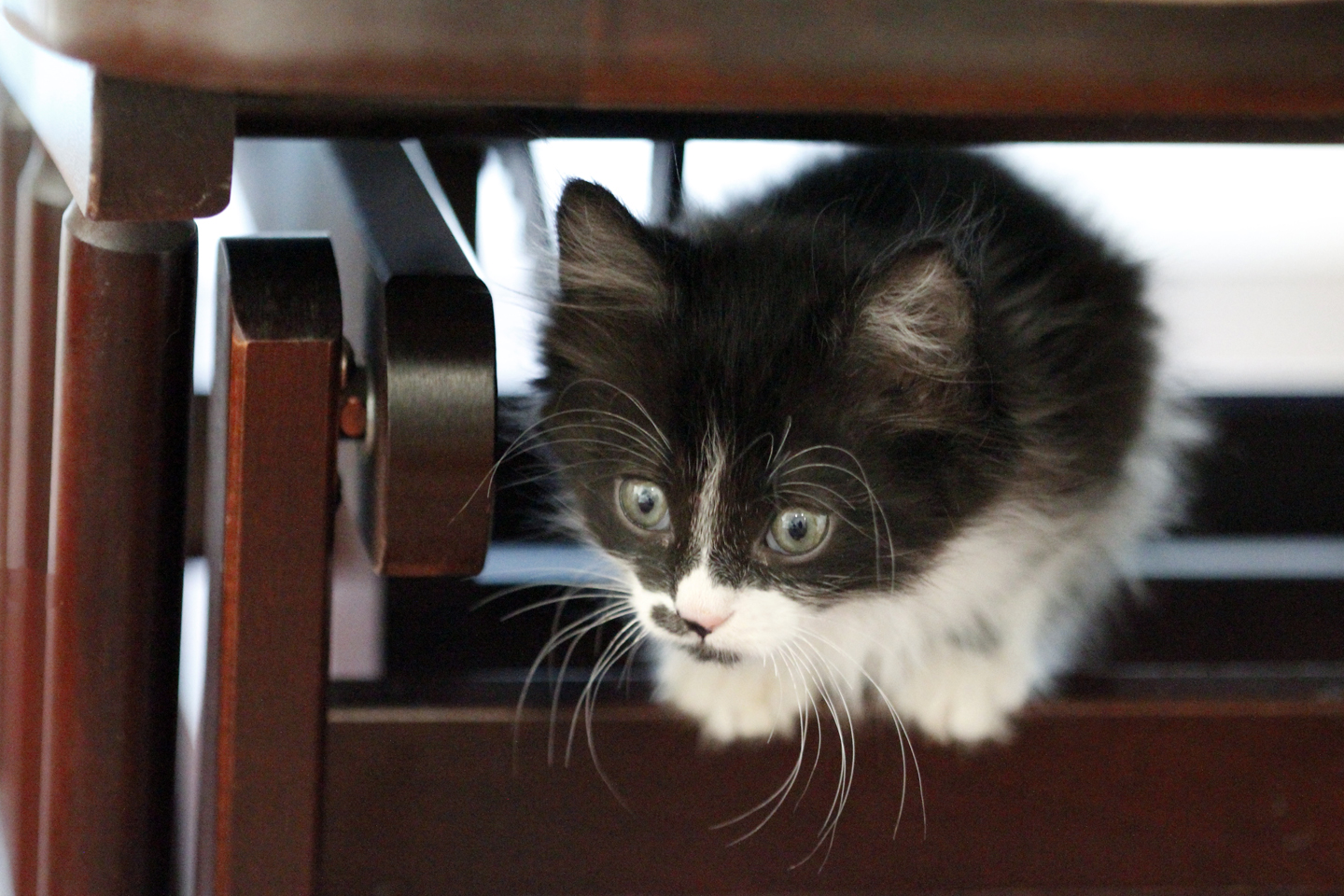
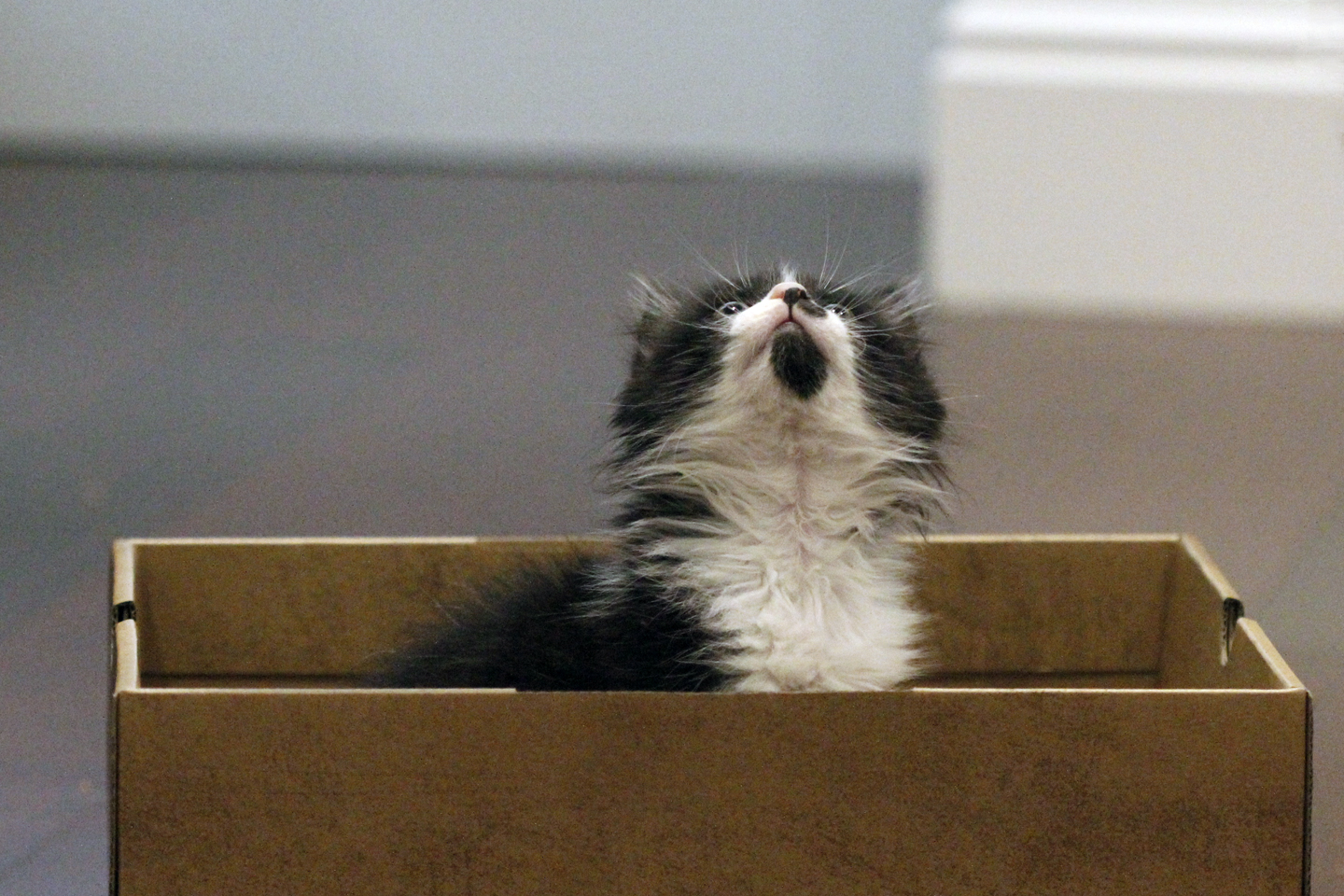
Pictured above: one of the foster kittens I had to return yesterday. Miss you, little guy. Wish I could have renamed you, since “Diamond” certainly doesn’t do you justice. (I thought maybe ‘Stache–for half a mustache–or Booger, but no one asked my opinion.) Hoping you’re feeling better soon. Maybe I’ll see you in the SPCA windows at Macy’s this season.
And for those of you who can’t stand cats, I promise not to mention them tomorrow.
For years, my mother kept a button exactly like the one pictured above tucked in a secretary desk in her bedroom. The desk was quite small and finished in country white, with an old-fashioned brass keyhole which was never locked. I would sneak into the room and unfold the desk, revealing all its odd treasures. My mother’s address book was kept there, bulging with notes and corners torn from Christmas card envelopes–so many that she held it shut with an oversized rubber band. There were also cubbies filled with neat little piles of precious papers, an empty jelly jar of dull pencils…and that button.
I looked at the button a lot. I remember its exact size and weight, the sharp barb of the pin. It was not the safety pin sort, but the kind that always protrudes, stabbing mindlessly at curious fingers.
When I consider it now, it is strange how much attention I paid to the little knick-knack. I suppose it looks impossibly mundane, but I loved it. You do gotta have art, I knew. We all knew. Between four siblings, we have studied modern dance, ballet, and theater, violin, piano, painting, photography, string bass, electric bass, viola, clarinet, drums. We got that message. And I loved the pun–“you gotta have heart”–another message taught repeatedly. But the pin’s motto had yet another layer for our family; my father’s name is Art.
We needed art and heart and Art.
I’ve been thinking about that button because my father would have been 85 today, and it is the first birthday to pass without him. As expected, I still need him.
I was a little tender already, then, when I took our three ailing foster kittens in for yet another vet appointment this morning. They have giardia, and though medicated, it’s not improving. One has eye infections, and one started bleeding. Caring for them has been nerve-wracking–they are so tiny, so fragile–and a pain in the neck. I never knew that diarrhea could be tracked up walls, on sinks, floors, doors, cabinets. Up the sides of the cat carrier. Matted in furry tails and feet and backs. How do you get poop on your back, my wee pals? Consequently, we’ve been laundering and bleaching the downstairs three times a day, and still can’t keep up. I shouldn’t have been surprised when the vet told me they would keep the kittens at the shelter instead of sending them back home with me. I should have been relieved.
Instead, I was shocked. My anxiety and love for the kittens, plus the frustration that I couldn’t help them, suddenly got confused with my overwhelming grief for my father, and I stood there, eyes welling over the exam table.
The vet smiled and closed the cat carrier. “Say goodbye to the kitties,” she said. “Nice and quick like a bandaid.” And that was it.
I walked out to the parking lot and sat in the car until I could see well enough to drive.
But unlike the proverbial bandaid, the sting has lingered all day.
From Illumination, an audio installation in the psych ward of the prison hospital–part of Alcatraz which is normally closed to the public.
“The misconception of totalitarianism is that freedom can be imprisoned. This is not the case. When you constrain freedom, freedom will take flight and land on a windowsill.”
— Ai Weiwei
After driving carpools to schools on opposite ends of town last Thursday morning, I put a feline fecal sample on ice in the trunk–oh! my glamorous life!–and made my way through the pouring rain toward Pier 39. As a San Francisco resident, I avoid that part of town like the plague. It’s crowded, kitschy, and leaves me feeling swindled and somewhat culpable. Did you make your way from some other continent to eat substandard, overpriced clam chowder out of a sourdough bowl? I’m sorry. I am.
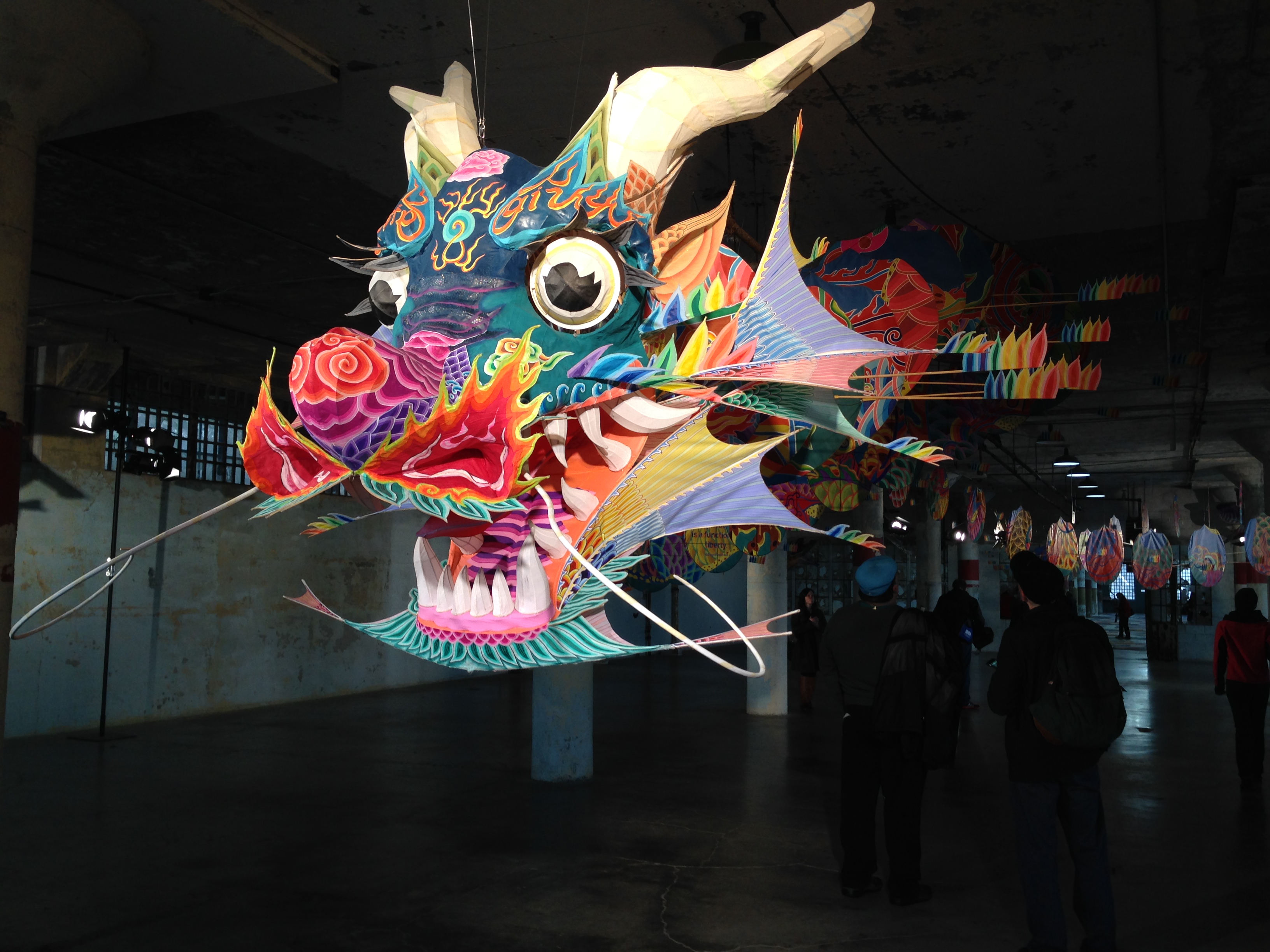
This time it was worth the effort and the heinous traffic, however. This time I was accompanying an art class on a field trip to the Ai Weiwei exhibition on Alcatraz.
It had felt like an indefensible luxury to take time from what I was supposed to be doing–working, tending to three sick foster kittens, preparing my presentation for the next day. What business did I have squandering four hours on art?
What I had forgotten is that art is not a luxury at all.
Art is good for the soul. Making it, viewing it, contemplating it, discussing it. It is the means for communication when mere words cannot convey what needs to be said. Art can speak truth to power, it can enlighten, it can challenge; it can soothe or amuse or complement the sofa. I’m not saying that all art is important, but rather that being able to do it and see it and think about it is vital. Where Ai Weiwei lives, his ability to make art is tenuous. He has been imprisoned and, after his release, continually harassed. His studio has been torn down by the local government in Beijing. He is forbidden to leave China.
I recall being in a snit once in art school, stressed out about some goofy project I had concocted–making portraits of George Bush by drizzling motor oil, of all things. “What am I doing noodling around in the garage while people are starving out there in the world?” I lamented to a friend. And she responded, “What sort of world would it be without any art?”
I think we both have a point.
Though unable to leave his country, Ai has somehow managed to create a provocative and politically charged show at a provocative and politically charged place. There are kites and legos and audio installations. You can sit in a cell and hear orchestral compositions written in a concentration camp or, a few cells down, hear songs by Fela Kuti, and the Russian punk band Pussy Riot. You can read about the charges against 176 political prisoners and exiles from around the world, and write them letters while sitting in the prison dining hall. These are “the heroes of our time,” as Ai says. They have had the courage to speak up, and they are paying a high price.
Ai Weiwei’s vision has landed on our windowsill. Go and see it if you can. 1.4 billion people will never lay eyes on it.
The head of the main kite in With Wind.From Trace, comprised of 176 portraits made from Legos.From Stay Tuned. It seemed to me that the walls were singing.
I was the youngest of four in a house with a cat and a dog, plus the occasional hamster, hermit crab, and a series of chameleons who would disappear and mysteriously wind up in the dryer. Despite this, my mother tried valiantly to keep tabs on me. At nine, when I was caught trying to read Sybil and Go Ask Alice, she repeatedly warned against inappropriate reading material.
Instead, I filched my sister’s copy of The Shining. I propped my social studies textbook on end and hid it inside, reading voraciously while Mrs. Denevan tended to the more flamboyant rulebreakers.
Jolene was the sprout of every girl who had ever hurt my feelings, reincarnated as a preschooler.
Yet my daughter was inexplicably devoted.
Ever hopeful, she would greet her wee frien-emy warmly.
Jolene would shriek and hide under the table. She would ignore–then punish cruelly if my child played with anyone else.
When confronted, Jolene would blame her actions on her delicate emotional state. “I’m really missing my mom today,” she would say, copping a sad face. “That’s why I’m making bad choices.”
But she would look me in the eye in a way that tipped her tiny hand.
In honor of the upcoming holiday, I wanted to take a moment to think about gratitude.
If that sentence gave you the heebie jeebies, join the club. For some unknown reason, I have a deep-seated repulsion for Chicken Soup-y type aphorisms and daily meditations.
Perhaps it is accentuated by the cliché art and bad fonts which typically accompany such things.
Don’t get me wrong. I love sunsets. In fact, I would be thrilled to be present for the moment depicted above. But what’s great about the setting sun over the lake is definitely not the cloying overscript on a two-dimensional reproduction.
Moreover, just because I won’t hang that poster doesn’t mean I have a beef with fostering gratitude. On the contrary! Gratitude is essential. I’m working on this often, striving to be a better person, and I certainly don’t want my kids to grow up to be selfish brutes. So…presenting…
A brief discussion of gratitude in a sans serif style.
Semi-recent articles in the Wall Street Journal, Huffington Post, the Atlantic Monthly, and Family Circle once again outline that teaching gratitude to your kids is important. Do it.
Why? Fostering gratitude doesn’t just make more tolerable people; it makes happier people. Jeffrey Froh (PsyD) did a study with middle schoolers. He asked one group to list up to five things for which they were grateful everyday for two weeks. Another group listed hassles, and the last group filled out surveys. The first group showed a marked jump in optimism and overall well-being that extended for a while, even after the study was completed. Those students also had a more positive attitude about school in general. Feeling grateful boosts happiness, gives people better perspective in life, and improves relationships at home, school, and work.
To sum up what I’ve learned…most experts recommend:
Model gratitude. Big surprise. Thank your kids. Thank your significant other. Thank friends, cashiers, relatives, teachers, baristas, maybe even the DMV clerk. After all, it must be a sucky job.
Give positive reinforcement. Even just “hey, thanks for noticing.” or “I appreciate your comment,” can help the set a pattern of behavior.
Give them less. Have kids work toward something they want, do chores, earn money. Let them know the value of an item. I could buy you those shoes, but then we can’t order pizza tonight. Lost a backpack? Help earn a new one. Talk about how work hours translate into garbage pick up, electricity, gasoline, vacation. Read aloud Farmer Boy, by Laura Ingalls Wilder. In addition to being a humorous and vivid story, it discusses hard work, chores, about wasting nothing. There is also a great discussion about the value of a silver dollar that Almanzo would like to spend at the fair. Another book recommendation: Laura Ingalls Wilder’s The Long Winter. If that doesn’t make you appreciate having heat and food on the table, I don’t know what will. Amazing.
Volunteer as a family. We’ve started very small. We collect our change and bring it to CoinStar periodically, which allows us to select a charity and send it electronically. What could be simpler? It teaches them that even pennies and nickels can add up to something significant. We’ve also baked cookies and given them out to homeless people, sold cupcakes to raise money for charities, and currently we foster kittens for the SPCA.
Coach when appropriate. I often have my kids make their own purchases, even when they are using my money. I remind them to say thank you (before or after the transaction, not during. I try to avoid barking at them while they are mid-transaction) and ask them to leave a tip when appropriate. They need little nudges along the way. “I was disappointed that you didn’t seem more grateful after I helped you with your homework. I could have been doing other things.” Reminding them of opportunities to be aware and thankful is not cheating.
Structure a moment of gratitude into the day. Practice, practice, practice! Gratitude is a muscle that needs exercising. Examining life for the positive helps lay new pathways in the brain, creating a positive mindset. That explains why Jeffrey Froh’s experiment had such an impact. This is big! I grew up saying grace at the table, so it feels natural to ask my kids, “What are you thankful about today?” when we sit down to eat dinner. I answer the question, too.
I highly recommend Shawn Achor’s TED talk on Happiness. Don’t be put off by its title: “The Happy Secret to Better Work.” It actually includes the happy secret to better life. There are amazing nuggets tucked in amongst some amusing anecdotes. Among them: “90% of your longterm happiness is predicted not by the external world, but by the way your brain processes the world.” In other words, by your MINDSET. Further study has shown that increasing positivity increases creativity, energy, and intelligence, because the dopamine released not only makes us feel happiness, it turns on the learning centers of our brains.
In the last two minutes of his talk, he outlines five quick and easy ways to increase happiness–based on research and not hopeful speculation. Guess what comes in at number one? Write down three new gratitudes each day for 21 days in a row. That is why I now have a gratitude journal, though I can’t call it that, of course. The phrase “Gratitude Journal” makes me gag a little. I have a crass name which I can’t repeat here, but which makes me laugh every time I take it out. I figure that makes me happier, too.
Sasha, we called her, not knowing it was usually the name of a Russian man.
Now the name has broadened for me. There are poets and Presidential daughters and even a pop star alter ego who bear the name. But as a child, the only Sasha in my world was our very bad dog.
My teenaged sister had endlessly begged for her, and sworn to train and care for her every need. Big surprise: I only recall seeing her once or twice with an empty milk carton and the ‘pooper scooper’ in hand.
Sasha was (of course) adorable as an incontinent mutt puppy. Puppies are charming. As she grew, however–unfettered by discipline and authority–she hardened my heart toward nearly every drooling crotch sniffer I would meet for the next couple of decades.
Sasha scratched our back door until the bottom right corner was worn thin, and flapped loudly with every paw nudge: her own relentless doorbell.
And if the door opened for any reason, that dog shot out like Usain Bolt after a case of Red Bull. The next 30 minutes were spent trying to find in which neighbor’s yard she was digging or defecating.
Since my sister was busy dating boys my mother disapproved of, I was often saddled with the job of dog walking. Sasha had a choke collar and what seemed at the time to be a twenty-pound chain. I would occasionally wrap it around my hand in an attempt to maintain grip on the wild beast, forgetting that this was the quickest way to crush my hand into a temporarily useless hunk of flesh. Sasha would lurch from the house, dragging me past a couple of houses before leaving me behind to nurse my fingers and hope she turned up shortly.
She had many other talents:
Stealing fresh-baked items from the dining room table. Sometimes whole cakes. Especially during parties, while people were distracted.
Vomiting.
Eating vomit.
Repeating cycle.
Bad breath.
Finding porcupines.
Lying in motor oil.
Eating frogs.
Getting unsightly mats in her fur from rolling in trash and dirt.
Hearing scissors open from 100 yards away–even when sleeping.
Due to the combined result of the last two, she once had a soup can lid stuck to her belly for a couple of weeks.
I have heard worse. I have heard of a dog that–during a time out in the garage–broke the car window and chewed through the dashboard to get to half a Power Bar in the glove compartment. Shenanigans like that are way out of Sasha’s league. To be honest, she did have some sweet moments now and then, and her shortcomings were the fault of her owners. Sasha was a part of my childhood and a member of our family, and it was a sad day when she succumbed to liver failure.
Just like on the previous fourteen days, I have been flailing around for a writing idea again today. As an added incentive, I told myself I couldn’t eat lunch until I post, which means I am getting ridiculously hungry and increasingly desperate.
So I have turned to a list of suggested writing prompts for assistance. Here’s sampling:
“Do you enjoy growing old or do you fight against it?”
No. I do not want to write about that. Does anyone? Perhaps yogis or saints.
Next up, “If you could permanently get rid of one worry, which one would it be?” You know what? Cataloguing and weighing each worry–starting with growing old, of course–has set off a mild anxiety attack. Thanks a lot, people.
Though it didn’t spawn ideas, this one did cheer me out of my funk: “You’re a Nigerian prince with millions in the bank but you can’t access it without an American co-signer. To your surprise and disappointment, nobody will help you transfer the money.”
Most promising at first read: “What is the one appliance that you can’t live without?” Easy: the toaster. Unfortunately, I don’t have anything to add to that besides the fact that toast is the most fabulous, most perfect food in the universe, unless you have run out of butter, and then…why bother?
Sadly, in the midst of my search, guess what appeared on the right side of my screen?
Dang. This felt personal.
Hm. Must be time to put this post out of its misery. Kudos to you for slogging through it. Any suggestions for getting unstuck are indeed welcome.
My brother-in-law is a very ambitious and successful guy. I asked him once, “how do you juggle everything?” And he told me, “Sometimes, when I’m hurrying from one thing to another, I pull over, turn off the car engine for two minutes, and breathe.”
His comment didn’t make much of an impression on me at the time. It wasn’t delivered in a “here’s what you must do to be amazing like me” manner. It was just honest and straightforward. And effective. Dubious? Try it yourself.
Today I would like to take a moment to mull over a few other comments that seemed very small at the time, and grew to be important tenets along the way.
“Don’t discount this young man just because he’s nice to you.” I was indeed surprised to hear a comment like that from my mother. Smart lady, though. I married the guy.
“Be more Beret.” This sounds like a no-brainer. People say things like “be yourself” and “be true to yourself” all the time. But somehow, throwing my name in there made all the difference to me. I thought, “I am Beret, how can I be more Beret?” I started small, of course. I started reading books that I like, instead of the ones I should read. I started saying no to things. I started saying yes to things. I started making time for things that make me happy. I started singing along with catchy songs even though they might be insipid. Who cares?
“You don’t have to love being a mother, you just have to love your children.” This was news to me. If I ever write a book about parenting, this is the quote I will use on the dedications page.
Lastly, when I started teaching, I didn’t go through the traditional credentialing route. I hadn’t taken any education courses in college, so I had a boatload of theory crammed into six or eight weeks one summer, and then I was thrown to the wolves. Terrified nearly to paralysis, I asked a seasoned teacher for a few wise words before my first day. “Always have an extra piece of chalk in your pocket,” he said.
When I tell that story to people they roll their eyes. “Nobody has chalkboards anymore,” they say. But while I am grateful for discussions of Paulo Freire’s Pedagogy of the Oppressed and Krashen’s Input Hypothesis,that teacher’s advice still rings in my ears. For me, it meant that no matter how great a challenge I was facing, how insurmountable and overwhelming it might seem, I could break it down into tiny, doable tasks. Likewise, despite the fact that the knowledge and skills we need as teachers/parents/humans are hopelessly infinite, we can start by learning one thing and building upon it.







 Bad Parenting 101